The Jackson Fireworks

— /

The Heartland Turned Out All Dressed Up for a Church Social and Michael Put On a Supernatural Display

By William Plummer  ~ July 23, 1984, Vol. 22, No.4

Four hours before show time on Friday, the six musicians in the Jacksons' tour band were pacing their rooms on the fifth floor of Kansas City's Alameda Plaza Hotel. Studio and live-show veterans all, they had rehearsed the 110-minute multimedia extravaganza for more than three months (most recently during a sound check that had lasted until 4 that morning), but all the preparation couldn't quiet their opening-night jitters. While they waited to board the unmarked vans that would transport them and the Jackson brothers to jam-packed Arrowhead Stadium, they smoked too much, consulted their watches and horsed around. "My stomach's got a butterfly in it the size of [sci-fi monster] Rodan," laughed keyboardist Pat Leonard, 28.

The Jacksons' sixth-floor enclave—where "Do Not Disturb" signs hung on the doorknobs—was absolutely still. Inside Michael's suite the Man himself was running through vocal exercises. In a room nearby, brothers Randy, Tito, Jermaine and Marlon—minus Jackie, sidelined by a knee operation—were rehearsing harmonies and bracing themselves for the start of the $50 million, 13-plus city tour that could mark the farewell of the family act that debuted in 1965. Little brother Randy was psyching himself up, trying to sear away the pain in his left leg caused by an auto accident in 1980. "You know how a boxer feels before a fight?" he asked. "That's how I feel. I want to knock them out."

"Pain pills," added Marlon. "We tell the audience to bring pain pills when they come to see us. We want to be so good, so strong, it makes 'em hurt."

Gluttons for the sort of punishment Marlon had in mind found it—and then some. The Jacksons packed Arrowhead Stadium for three nights running, and the chief complaints among the 135,000 who witnessed their spectacle was that the brothers hadn't given them enough licks. "I'd like to see twice as much," said 19-year-old Donna Slonaker, from Lydon, Kans., "but I'd pay $30 to see it again."

After months of controversy, suspense and confusion, the Jackson Victory tour—named in honor of the newly released album that has already sold nearly two and a half million copies—was finally on the road, bound next for Dallas, Jacksonville, New York and points beyond. All told the five Jacksons expected to play 47 dates in 16 weeks to the tune of $50-$60 million in ticket sales—and a possible $8 million profit.

When they weren't fielding criticism about the tour's exorbitant mail-order ticket policy (which has been changed) and promoter Chuck Sullivan's demands for reduced hotel rates and free newspaper ad space, the close-knit clan had spent its pre-V-Days polishing the act. There was none of the ambitious partying that once characterized rock tours: Meals prepared by the Jacksons' two cooks were taken in the privacy of the brothers' rooms. Idle moments were devoted to playing riffs and (in Michael's case) autographing photos. The Gloved One slipped out of the hotel (via an elevator leading to the garage) to see Ghostbusters and to announce publicly that he would donate his share of the concert proceeds to charity. On Friday afternoon he accompanied Tito to a local hotel to accept an NAACP award. After that outing, the Jacksons remained en famine until Friday evening, when dressers came to help them into the opening-number costumes. At 9 p.m. the five hopped into a van for the 30-minute ride to the stadium, where the frenzy was cresting.

The audience that awaited them was a Whitman's sampler of Middle America. They arrived in muddy pickups and customized vans and sporty coupes—not just squealing adolescents in T-shirts emblazoned with Michael's likeness, but old people as well, and mothers with toddlers, and a rainbow coalition that only these Jacksons could bring together: young people with their parents. Said Andrea Gilliand of Stanley, Kans., speaking from the promontory of 30, "You're never too old to see Michael Jackson. It's the best concert I've ever been to, and I've seen the Stones and the Beatles. But why didn't he play 'Thriller'?"

Well probably because he wanted to make his fans privy to the movie that screens daily behind his eyes. The script, for which the androgynous idol did the storyboards, is Arthurian legend as if spruced up by Star Wars creator George Lucas, with an assist from Muppeteer Jim Henson. At the show's opening, towering animated monsters thunder onstage, to be challenged by Randy (Michael's creative heir apparent), done up in glittering armor. Randy pulls a laser-lit sword out of a prop rock, slays one of the creatures and commands, "Behold the Kingdom." Belching smoke shot with green and blue and purple, the set elevates and out come the brothers, who make a dramatic descent down a set of newly revealed stairs into a deafening wave of screams.

Although Jermaine sings lead on three of his own songs and the other Jacksons have their moments, Michael seizes center stage and holds it. Resplendent in a silver sequined jacket with a red-and-white sash (one of his four costumes), he leaps into the air, freezes, whips about, drops to one knee and curls into a fetal position. He's arrogant on Beat It, tender on She's Out of My Life, triumphant on Billie Jean. His Heartbreak Hotel is so full of pops, stops, bangs and breaks that by the time he's done the crowd is inspecting its arms for imaginary bruises.

The Jackson tour is a spectacular production, and it comes with a spectacular price tag: in the neighborhood, says promoter Sullivan, of $15 million. The 375-ton stage, itself a costly proposition, is five stories high, 160 feet wide and 90 feet deep. It has seven computers and five elevators that require 22 men to operate. What with the 120 speakers, 2,200 lights, and the trestles and cables, the Jacksons' baggage adds up to some 65,000 pounds. The crew numbers 1,500, including those recruited locally to stage the finale—a sky-splitting fireworks show.

At Arrowhead more than 170 officers from area police departments kept the peace. They were abetted by 375 security guards hired by the stadium management, nine paramedics, two doctors and six nurses. A helicopter and four ambulances idled at the ready, and the crowd was frisked at the entrances by nearly 70 hand-held metal detectors. In fact security was so tight that Sullivan himself was denied backstage access on opening night when he forgot his pass.

Happily, the Jackson tour brain trust—which had prepared for a disaster on the order of the Stones' 1969 concert at Altamont—was confronted instead with the docility of a church social, a decorous reflection of Michael Jackson himself. Only nine arrests were made at Arrowhead, says a stadium spokesman, most for disorderly conduct. The only real high jinks came from Don King, the fright-wigged boxing czar and erstwhile tour promoter. Supplanted by Sullivan in June he nevertheless continued to hold forth as if he were running the show. "We're traveling virgin territory," he announced as he held court in the Alameda Plaza lobby. "There are no boundaries. If Michael had time to work as hard as Wayne Newton, 150 dates a year, he could make $200 million. But who wants to work that hard?"

The Jacksons worked hard enough as it was. But the threat of exhaustion seemed irrelevant to Randy, who elatedly hopped about on hotel chairs Saturday as he relived the electrifying opener. "It was great to be back up there," he said. "My leg was killing me, but I know it was the best opening show we've ever done. Afterward I couldn't sleep. My mother called just to say 'I love you and thought you were good.' My mother's all about love."

Meanwhile, down in Jacksonville, Mayor Jake Godbold was also falling in love. "It's time we reached for the stars," he said. Godbold had calculated that the Jacksons' three-day stint in his fair city would cost the local government $445,000 in salaries and promotions—a piddling sum compared to what visitors would spend for lodgings, meals, gas and Michael Jackson geegaws. "Seventy million dollars," he told the City Council, lingering over the last word. "Seventy million dollars."

Contributors:James McBride.


i like grapes

— /
A cute story from David Gest (sometime in the 80s)


Michael was staying at my place on Dohney and was happy to come along. He really respected Burt (Bacharach) but wondered, as we all did, what made him tick. Burt had ordered a bottle of expensive French red wine, which he, Carole (Bayer Sager) and I were drinking. Michael never drank but that night he got interested in wine. Unbelievably; he didn’t even know what wine was.
‘What’s it made of?’ he asked me.
‘Grapes’, I said.
‘I like grapes,’ Michael said. ‘I think I’ll try some.’

So we poured Michael a glass and he drank it. He obviously liked it because he drank another one. We were drinking a 1982 Pomerol that tasted like candy, so he was bound to like it.
By this time, we all had a glass or two and the bottle was finished. So Burt ordered a second bottle. This time, Michael drank virtually the whole bottle. He had really acquired a taste for wine, fine wine at that, and was guzzling the stuff down. So we ordered a third bottle and Michael drank most of that as well. That’s when I knew we were going to have a problem that night.

The evening came to an end and I drove Michael back to my place. He was, understandably, happy. In fact, he was flying high, very high. In the car he was talking and laughing. He was singing ‘I Want To Be Where You Are’ and ‘Never Can Say Goodbye’.
Then he started singing more of his hit songs like ‘Ben’. He was giggling away all the time.
‘You’re going to be in trouble,’ he said. ‘I’m going to tell Joesph what you did.’
I wasn’t taking the bait. ‘I didn’t do it, you did,’ I said.

It took us a few minutes to get back to my place. The minute I parked the car and opened the door for him, Michael leaned out and threw up all over the place. He spent the rest of the night hanging over the toilet. He was as sick as a dog. I was up all night with him.
He kept saying, ‘I’m going to tell Joe you corrupted me,’ I was kinda worried he would but he never did.
It was his first taste of wine, something he would come to love a little too much in later years. I always felt bad about that night but it sure was funny!

Michael's First Epistle

— /

In the Midst of a World Tour, the Astonishing Star Breaks His Four-Year Silence to Issue a Cry of Pain from Japan

By Michael Small  ~ October 12, 1987, Vol. 28, No. 15


As the clock ticks down toward show time at Japan's Yokohama stadium, the teenagers staking out a closely guarded back entrance grow edgy with excitement. Aware that their fleeting brush with a legend is at hand, they murmur, "Sugu, sugu!" "Soon, soon!" The sight of two vans—one blue, one gold—swinging round a corner brings instant recognition, and the crowd erupts with a joyous roar. As the rockmobiles come slickly to a halt, a lithe young man steps out, and for a second the stadium lights reflect brilliantly off the extravagant silver buckles of his jacket. Then he disappears behind a door labeled, in light-blue letters, Mr. Michael Jackson.

Backstage at this ninth Japanese concert of what is to be a yearlong world tour, Michael Jackson radiates energy: His arrival sends a jolt of pre-show electricity through the cast and crew members who had been lazily hanging out around his simply furnished dressing room. Jackson rolls his head to limber up; gazing in a full-length mirror, he flicks a speck of loose makeup off his cheek. His toned, 5'10" frame seems imposing, quite at odds with the waif like image he presents to photographers. "I'm getting a little worried about my voice getting thin," says Jackson in a voice stronger and more assured than the shy squeak of his rare public pronouncements. "But so far things are going good."

Out front, the stadium is a powder keg awaiting the match. Christened Typhoon Michael by the Japanese press, Jackson has taken the nation by storm. The 38,000 seats for tonight's concert sold out (at $40 per) weeks ago, and some fans desperate to hail the man they call My-ke-ru have paid scalpers $700 to get in. But here in his dressing room the rock phenomenon lingers over a cup of tea, calmly ignoring the gathering clamor from the arena and the rising nerves of his 15 backup musicians and dancers. A crew member recites a brief prayer, then Jackson huddles with his cast like a football quarterback. They clap their hands and stomp their feet. "Whatever we play," yells Jackson, his smooth, sculpted features relaxing into an engaging grin, "it's got to be funky!" A moment later, to a burst of bright lights and thunderous applause, they jog onstage.

So goes the stage life of the world's most popular rock star: glitter, fame, excitement and wealth. Real life is, of course, another matter. The August release of Bad, his first album in five years, brought with it a flood of wild rumors. Jackson has been accused—and, despite his denials, accused again—of using chemicals to make his skin lighter, of transforming his entire body with plastic surgery, of taking female hormones to keep his voice high and of refusing to bathe in anything but Evian water. Having said no more than a few words to the press since 1983, Jackson left it to his stogie-chomping manager, Frank Dileo, to explain away his plastic surgeries (just the nose and chin were done, he said) and his attempt to purchase the bones of the Elephant Man ("Well, everyone has a skeleton in their closet," Dileo told PEOPLE). Probably the tall tales only enhanced sales of Bad, which has already zoomed to the top of the charts in at least eight countries. But the rumors' effect on Jackson, 29, has been anything but salutary. "It's really horrible to have these lies printed about me," he says. "It hurts."

Driven to the brink during his Japanese tour, he did something last week that reveals a sorely troubled man very different from his magical persona: He sat down at the desk in his room at the Capitol Tokyu Hotel in Tokyo and, on the back of a piece of hotel stationery, wrote what he said would be his only discussion of his private life. "Like the old Indian proverb says," wrote Jackson, "do not judge a man until you've walked 2 moons in his moccosins." The singer's two-page missive reveals him to be a complex mix of boy and man whose personality matches the themes of Bad, an album so full of bright, catchy dance tunes that it's easy to overlook the lyrics that express dark fantasies and hyper-romantic dreams. Jackson offers forgiveness to the rumormongers who have upset him: "Animals strike, not from malice, but because they want to live, it is the same with those who criticize, they desire our blood, not our pain." At the same time, he expresses himself with the desperate tone of a child who has been unfairly punished: "I cry very very often because it hurts.... Have mercy, for I've been bleeding a long time now." His casual spelling and punctuation speak of backstage tutors and self-teaching, but his expression of pain is clear.


If what he wrote is what he truly feels, Jackson's powers of concealment may be his most dazzling talent. From all appearances, he has complete control of what he has described as the only solo tour of his career. While the 150 crew members of the Jacksons' 1984 Victory tour felt chaos around every corner, Michael alone directs the 90 members of his solo show. He approves every photo and backstage pass, and he personally signed off on every detail of a 100-minute, 16-song show that costs about $500,000 a week to produce and includes lasers, explosions and a breathtaking magic trick that levitates him across the stage. (After Japan, Jackson plays Australia and New Zealand before returning to the U.S. in December.) His own performance—as a singer and dancer whose moves seem to defy the laws of both physics and aerobics—has been worked and reworked to perfection, and with a repertoire that includes only two songs from Bad and lots of old favorites from Thriller, he has thoroughly wowed his every audience in Japan. Sheryl Crow, who duets with Jackson on the ballad "I Just Can't Stop Loving You", says, "I have a hard time keeping my eyes off him. When he's onstage, he just keeps drawing you in."

From the moment Jackson stepped off the plane to face a Nikon tiring squad of 600 photographers and 1,000 fans, the Japanese have given him a welcome reminiscent of the Beatles' first trip to the U.S. Jackson posters line city walls; his face decorates shopping bags. In the heart of ultra-high-rent Tokyo, Nippon Television set up a store that stocks only the fast-selling paraphernalia endorsed by Jackson-san. Two amusement parks shut down to provide free access when the reclusive singer and his entourage requested private playtime.

Fans Emiko Haga and Miki Ikeda, both 20, are traveling with a pack of several other girls who have saved their yen so they can follow Jackson around Japan for his entire tour. "We are trying to see him every minute of every day, except when we sleep," exclaims Haga. After meeting Jackson on Japan's Bullet train, Ikeda started to cry. "I said, 'I love you,' " says Emiko. "He said, 'Thank you.' It was unbelievable."

Equally unbelievable is the commercial consequence of all this adulation. The money is flowing into Jackson's bank accounts in cataracts. About 450,000 people will attend his 14 sold-out stadium concerts, and Bad is confidently expected to sell 500,000 copies in a country where only phenomenally successful records sell 200,000. All told, Michael will gross at least $20 million in Japan alone. Not Bad.

The temptations of the road that have led so many rock performers into deep trouble seem not to be a problem for Jackson. Never romantically linked to anyone during the years that he confined himself to the Los Angeles mansion he shares with his parents, Jackson has not been spotted with a date on tour either. He has visited with friends Gregory Peck and designer Issey Miyake, but mostly he socializes with two favorite companions: his manager, Frank Dileo, and his chimp, Bubbles, from both of whom he seems to derive a good deal of fun and comfort. It would be difficult to imagine a figure of less physical resemblance to Jackson than Dileo, 39. Portly, short and balding, the colorfully loquacious Dileo has become Jackson's most trusted confidant. Determined to erase unflattering descriptions of Dileo by the press, Jackson calls him "my shield of armor, my other half. We dream together and achieve together." As for Bubbles, a 3½-year-old chimpanzee released from a cancer lab in 1985, he eats at the table with Jackson, mimics his master's moonwalk, plays hide-and-seek, plays dead, blows bubbles and joins in pillow fights. The Japanese find it all fascinating. When Bubbles arrived in Japan on a separate flight from Jackson's, he got a Very Important Chimp reception from 300 photographers. The Mayor of Osaka later entertained Michael and Bubbles at a formal tea ceremony. "Bubbles is so popular here," says one Tokyo merchandiser, "that if he announced he was doing a concert tour, he'd sell out."

On off days Jackson has ventured out to shop for clocks, Japanese art books and a colorful Oriental screen. He also plundered two of Japan's biggest toy stores: Dileo won't disclose what the singer purchased, but jokes, "His hotel room is a mess. I told him it's starting to look like his room at home."

If Jackson does at times resemble a child, it may be because he identifies so closely with children. Quietly he has given rafts of free concert tickets to handicapped youngsters, visited Japanese schools and sent condolences and $20,000 to the family of 5-year-old Yoshiaki Ogiwara, an Osaka boy who was kidnapped and murdered recently. At one concert he dedicated his tour to the boy, a gesture that brought tears to the eyes of adoring fans. "People just don't have a realistic picture of who Michael is," says makeup artist Karen Faye. "He's innocent and inspiring without being preachy—and a lot of fun to be around."

To his public, however, Jackson remains an enigmatic figure, and his handwritten message from Japan will do little to change that. Given his near total blackout on personal press, one can only assume he wants it that way: Anonymity serves his stagecraft. Last week in Tokyo's gaudy, neon-lit Ginza district, throngs of young people crowded the sidewalks, drawn by the rumor that Jackson was to appear for a PEOPLE photo shoot. When he arrived the screams rose to a frightening pitch, and the hysterical young fans hurled themselves at his barricade of bodyguards. Yet, while the photo op dissolved in chaos, Jackson remained implacably calm. He smiled broadly, threw up his arms in a dramatic gesture, then vanished into the night.

The effect was stunning, Olympian: A god had come and gone. Offstage and out of costume, the Michael Jackson who was "sent forth for the world, for the children" could hardly help feeling chagrined that his stage persona is only an act. Gods, after all, do not feel pain.

    Contributors: Todd Gold.

a photo to remember

— /

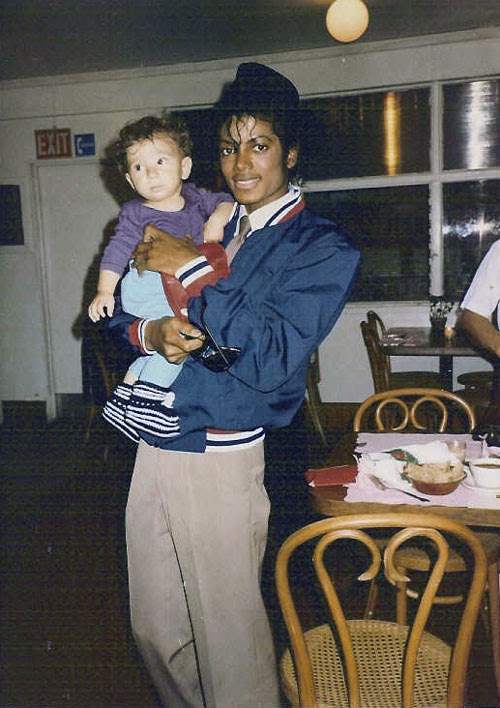
It was just by coincidence that I became acquainted with Michael Jackson. It was 1983 and my wife, Flora, was pregnant with our first child. Frequently, we ate at a vegetarian restaurant called The Golden Temple. Generally we went during the hours between lunch and dinner. There were few other customers during that time period, but there was one other regular: Michael Jackson. He had recently become a vegetarian, and he was fascinated to follow the progress of a vegetarian pregnancy. When our son, Elijah, was born in June, Michael was excited to see him. Once he asked me what it was like to be a father, and he told me that that was what he wanted most of all in life: to have a child of his own to take care of. Even then, there was something poignant about this man who had not been allowed to be a normal child himself wanting to be a father.

On February 18, 1984, when Elijah was eight months old, we took him to The Golden Temple. There were no others customers except Michael and his 13-year-old friend, Emmanuel Lewis, who was known to the world as "Webster." Michael said that he wished he had a camera because he wanted his picture taken with Elijah. My wife had a camera in her bag, but no film. Michael suggested that she could get some film at a nearby drugstore and asked if he and Emmanuel could take care of Elijah while we waited. When Flora returned, Michael suggested various poses and she snapped a number of photos of Elijah with Michael and Emmanuel. Michael asked for copies of the prints when they were developed.

Each of the photos turned out to be of interest, but there was one, of Michael holding Elijah in his arms, that stood out. Looking at it today, 25 years later, and seeing Michael's bright look and clear smile, I can't help but feel sad. He looked healthy, happy and untroubled. His album Thriller had caused a sensation. "Beat It" had been released only four days earlier. And ten days after that afternoon at The Golden Temple, he won eight Grammy Awards. When we next saw him at the restaurant just after his night of triumph, he was beaming, but he also seemed a bit embarrassed by his success.

I got a lot of mileage out of that photo of Michael Jackson and Elijah. Whenever I traveled, I brought with a packet of family photos. The Michael and Elijah photo was the last in the set, and when people got to it, they were usually stunned. Wherever I went, China, Russia, Burma, Tahiti, everyone recognized Michael Jackson. I have to admit that, as a journalist, I used it to put people at ease when I wanted to interview them.

As the years passed, Michael Jackson looked less and less like the Michael in the photo. His skin color changed; the shape of his nose and face changed; and that look of happiness and contentment disappeared.

Now that he is gone, I want to share that photo of Michael Jackson, from a time when he appeared to be at peace with himself and with the world. This is the way I want to remember him.

rolling stone australia - october 2012

— /


 FULL ARTICLE: Rolling Stone Australia (Issue 731) October 2012 

Michael Jackson: The Rise Before The Fall

In 1986, Michael Jackson presented his then manager Frank Dileo and accountant John Branca with a mission statement telling the two men that he desired for his "whole career to be the greatest show on earth". To help guide these members of the Jackson inner circle toward this destination, he
handed the pair an autobiography of PT. Barnum, a book the performer had read numerous times. Born in 1810 in Bethel, Connecticut, Barnum was the Godfather of the public spectacle writ large. He was both a scam artist and the originator of The Ringling Bros. & Barnum & Bailey Circus, a traveling spectacle on a scale sufficient to still draw thousands of people to New York's Madison Square Garden each April. Of his own ambition to be remembered as the ultimate show-business impresario, Barnum - a man known as "the prince of humbugs" - is quoted saying, "I am a showman by profession...and all the gilding will make nothing else of me."

"This [book] is my bible, and I want it to be yours," Jackson told Dileo & Branca.

Had Michael Jackson spoken these words prior to releasing his fifth solo album, 1979's Off The Wall, the logic of his desire would be as clear as the tone of his singing voice. A child star with the Jackson 5, over the course of four solo albums (the first of which Got To Be There, was recorded when Jackson was just 13) the performer had gradually been stearing himself away from the perception that his fame was rooted in his role as the cute kid in a family band ruled by a tyrannical and abusive father. This pursuit, though, had yielded only the pale and frail shoots of promise. His fourth solo album, 1975's Forever, Michael, had peaked at a mere 101 on the US Billboard Album Chart and had failed to register on a chart anywhere else in the world.

Off The Wall would change all that. Soaring in the slipstream of the number one single "Don't Stop 'Til You Get Enough", the album was a hit in the fullest sense of the term. Someone asked to guess the point in Jackson's career when he and his team engaged in a P.T. Barnum-inspired, image-changing think tank could be forgiven for assuming it was prior to the release of Off The Wall.

But even success would be eclipsed by the shadow of it's successor, 1982's Thriller. A perfect storm of an album, the nine-song set was launched into the stratosphere by the unquestionable brilliance of singles such as "Billie Jean", "Beat It" & "Thriller". The last was bolstered with an extended video clip created by Trading Places director John Landis - a clip Jackson's label Epic, initially resisted, believing the parent album to have run it's commercial course - not to mention production at the hands of Quincy Jones that even today lends the work of freshness and vitality.

The result was that the man whose face adorned the cover of Thriller became without question the world's most recognizable pop star. This in itself was a monumental achievement. For if the 1970s were the decade that saw the rise of the rock group (with acts such as Led Zeppelin, Fleetwood Mac & Pink Floyd filling stadia in the US, Europe & beyond), the 80s were a period that belonged to the solo superstar, with songwriters such as Billy Joel & Steve Winwood rising to international prominence in a heavily stylised fashion. The decade also saw the emergence of performers who understood that the stage they aspire to dominate was no longer merely a place of song. Artists such as Madonna and Prince were savvy to the emergence of the cult of the celebrity, of multimedia presentation, and a required sense of both omnipotence and mystique.

Compared to Michael Jackson, however, the 1980s were a period when even Madonna dined below the salt. As if to support this notion, in 1985 Jackson co-wrote "We Are The Wold" with Lionel Ritchie, a single released to raise funds to combat famine in Ethiopia, and which featured contributions from among others, Bob Dylan, Paul Simon, Stevie Wonder, Bruce Springsteen, Diana Ross, Willie Nelson and Cyndi Lauper. Prior to the recording of the single that would out its initial print run of 800,000 copies in just three days, producer Quincy Jones placed a call to Jackson and Richie saying, "My dear brothers, we have 46 stars coming in six weeks and we need a damn song."

The truth was that Michael Jackson required more than just one "damn song". He needed to compile an album's worth of new material. Unlike today, the 80s were not a period that saw artists take 3,4 or 5 years between LPs. A cultural colossus he may have been, but as the middle of the decade nudged toward the top of the hour, the artist was wanting for the one thing that had provided him with the blocks on which to build his enormous public profile: music. What's more, as with time, music critics and cultural commentators wait for no man. As the US magazine Spine noted in 1985, "[Jackson was] facing the most powerful backlash in the history of popular music".

The situation was this. Michael Jackson was the biggest star in the world. He had put his name to the best-selling album in history, a record that even at the time had sold 38.5 million copies, 30 years after its release would reside in the homes of an astounding 110 million people. But the time had arrived for the world to discover what Jackson had in mind for an encore.

Steve Stevens was in bed at home in Manhattan when the phone rang. By his own admission the guitarist had enjoyed "a late night" and was enjoying a late sleep just as much. Known as the wingman for Billy Idol - another solo superstar at the time - as well as one of the finest players of the era, the Brooklyn-born musician answered the phone, and a voice fogged with the bass of broken sleep, spoke into the receiver. The man on the other end of the line announced himself as Quincy Jones. In response to this, Stevens "proceeded to hang up" assuming "that someone was fucking with [him]". Moments later, the caller rang back, informing his listener that were the line to go dead a second time it would not ring a third.

Jones, the producer of Off The Wall & Thriller, was in the market for a lead guitarist to play on a song titled "Dirty Diana", a track on Jackson's forthcoming album, Bad. The producer was friends with Ted Templeman, the man who had not only manned the controls for Van Halen's body of work (in fact Eddie Van Halen himself had supplied the sumptuously excessive guitar solo featured on "Beat It"), but who was also Steven's A&R man at Warner Brothers. Jones was calling to invite Stevens to contribute his considerable talents to the most eagerly awaited album of the decade. Unsurprisingly, the guitarist agreed; surprisingly, though, his acquiescence came with a condition: Jackson's presence was required in the studio.

"I had done some session work in the past and I assumed that the artist would be in the studio," recalls the musician. "But it turns out that this isn't the case. It'd be me, the producer and the engineer. And I though, "Well, Im not cut out for that kind of thing. Im not into assembly line-type work'...[But then] I was told, 'Of course Michael will be in the studio, it's his fucking album!"

The scene that greeted Stevens upon his arrival at Westlake Studios in Los Angeles in April 1987 both surprised and delighted him. The guitarist admits to being "a little nervous" regarding the session, but these nerves were put at ease by the atmosphere in the room. For a man whose life was increasingly becoming shrouded in the smoke and mirrors of a deeply odd cult of personality, the sight that greeted the New York axeman could not have been more normal or convivial. The only people present were the artist, the producer and the engineer; the style of guitar solo was explained to the musician by Jackson himself, and after Stevens had laid down his track in adherence to these guidelines, he was then invited to improvise his own take. The process of capturing lightning in a bottle took less than four hours. During this time, Jackson would quiz his guest on the subject of hard rock, with questions such as did Stevens know Motley Crue, and if so, what were they like?

"It couldnt have been nicer," recalls the guitarist. "It couldn't have been cooler. It was all about the music."

But if Stevens' memories of his time with Jackson are coloured by a working environment that was both enjoyable and efficient, at other times the making of Bad was a more complicated process. Pre-production work on the album began in 1985, two years before the finished item was finally released. During this period, there was many a slip between cup and lip. Jackson had intended that his seventh studio release would feature collaborations with such artists as Aretha Franklin, Whitney Houston, Barbara Streisand and Run DMC, none of whose voices made it on the album. The time between Thriller and Bad had also seen the emergence of another African-American sensation, Prince. Jackson viewed the Minneapolis-born artist's 1984 album Purple Rain as being Bad's main competitor, and desired his forthcoming work to be edgier and darker than Thriller. Plans were even laid for Prince to appear on the record's title track, and for a video to feature a competitive showdown between the two artists. Prince declined this offer feeling that the denouement of the clip would cast him as the inferior performer.

"As Jackson planned it," wrote J.Randy Taraborrelli in his biography Michael Jackson: The Magic, The Madness, The Whole Story, "he and Prince would square off against one another [in the video] taking turns vocalising and dancing, in order to determine once and for all who was 'Bad'."

Along with the numerous planned and aborted collaborations, the relationship between Quincy Jones and Jackson also came under strain. Jones was credited as sole producer on both Off The Wall and Thriller, while for Bad this role was shared with Jackson himself. The performer also had insanely high expectations for his forthcoming release. He taped a note on to a mirror that read simply "100 million", this being the sales figure he wanted the new album to attain. The proposed tally was more than twice that achieved by Thriller. As the ground was prepared for the release of Bad, Rolling Stone reported that Jackson had compiled no few than 66 songs and planned to release 33 of these tracks in the form of a triple album, an idea nixed by Jones. That said, the 11 tracks that comprise Bad were subjected to an obsessive attention to detail. In pursuit of creating sounds that, according to Jackson, "the ear hadn't heard", the album's 48 mins and 16 seconds were layered with 800 multi-track overdubs. To say the least, the LPs birth was not without its complications.

"There was much stress," recalls session guitarist David Williams, who played on the album, as quoted in Joseph Vogel's Man In The Music, the Creative Life and Work Of Michael Jackson. "I was doing the exact same part at least five times on each song."

As reported in the same book, Jackson himself admitted that "[Quincy and I] disagreed on some things. There was a lot of tension because we felt we were competing with ourselves. It's very hard to create something when you feel like you're in competition with yourself."

Creativity, though, finds its release from energies both positive and negative. In the case of Bad, these energies were not wasted and in fact could be heard on every note of every track. Clearly this was a creation worth the candle. A sophisticated and seamless mixture of modern rhythm and blues, pop, dance and rock, Jackson, Jones and a cast of no fewer than 21 musicians and studio technicians had created a set that catered to the tastes of mainstream America with an uncommonly high regard for artistic detail and which featured numerous creative peaks. Once such peak was the blockbusting hit single "The Way You Make Me Feel", the beat of which was actually suggested to Jackson by his mother, and which keyboardist Greg Phillinganes recalls with fondness saying, "I remember how much fun I had laying down those off-beat parts...and watching the expression on Michael's face - he'd have that big grin that meant you had it." Elsewhere, Bad's unforgettable title track - the second single release from its parent album - showcased not only Jaxkson's musicality (the songs writing credit belongs soley to Jackson) but, as with the video for Thriller, the artist was once again able to prove to watching eyes that his sense of presentation was of sufficient dimension to grace even the largest canvas. In this case the splash came with a 17 min music video directed by Martin Scorsese, the finest filmmaker of his generation. The clip featured a largely unseen prelude which saw Jackson in a confrontation with Wesley Snipes. Film director Allen Hughes - who along with his brother Albert, has co-directed such pictures as From Hell and The Book of Eli - once told MTV News that Jackson's performance in the sequence was the work "of an incredible actor".

With the sessions for Bad finally wrapped and the set ready for release, Jackson described his state of mind to Ebony magazine as being one of "jubilation". The album met its public on the final day of August, 1987. Immediately, the LP became airborne in a manner that suggested it had been launched from Cape Canaveral. The 11 song creation entered the US Billboard Top 200 at number one, holding this position for 6 weeks while outselling every other LP in the Top 40 combined. In the UK, Bad sold half a million copies in its first five days of release, while elsewhere the set reached the summit of album charts in no few than 25 countries, including Canada, Japan & New Zealand. In Australia the LP missed the top spot by just one place.

In terms of the critical reception afforded the work, Rolling Stone writer Davitt Stigerson opined, "Even without a milestone recording like "Billie Jean", Bad is still a better record than Thriller." New York Times critic Jon Pareles described the set as "a gleaming, high-tech dance record thats just a little bit eccentric at the edges". Also on America's east coast, the notice published in The Washington Post, written by Richard Harrington, was of the opinion that Bad was "immaculately produced" and featured "some scintillating vocal performances from Jackson", before wisely adding, "Splashy though its prime-time introduction may be, the album begs to be judged by its music, not by its sales figures."

Today the release of Bad demands to be considered in the context of its time. The 80s was the period that saw the emergence of the cult of celebrity, with Michael Jackson both subject and progenitor. Given this, it is hardly surprising that many commentators lacked the wit, or humanity, to separate the art from the artist. One reviewer seethed that Michael Jackson image on the album's frontage featured "a face as plastic as the album it covers", pronouncing, "Wacko Jacko steps back into the limelight even more girlie than before." This kind of poison seeped into public consciousness rendering the artist a polarising presence. In a 1988 Rolling Stone poll, Jackson was voted "Worst Male Singer", while the CD on which he had most recently sung occupied the number one spot as "Worst Album".

It became less a case of the man in the mirror than the man in the media. as first hand contact with journalists grew increasingly rare, excluded publications and their gossip columnists filled this vacuum with bizarre speculations and often outright falsehoods. While a wild story was occasionally true - for example, Steve Stevens recalls Bubbles, the performers pet chimpanzee, being in attendance for the "Dirty Diana" video shoot - many reports were based on smoke without fire concocted by Jackson's inner circle. One story that appeared during this time was the "news" that Jackson spent his nights sleeping in a hyperbaric chamber capable of extending his life expectancy to 150 years. This was a piece of fiction concocted by Frank Dileo and leaked to the American tabloid National Enquirer. In no time, the allegation was common currency from Alaska to Adelaide. The subject of this nonsense was delighted by the story's shockwaves saying, "It's like I can tell the press anything about me and they'll buy it."

One man who over the years was afforded privileged access to Michael Jackson was music journalist Ian "Molly" Meldrum, who during the course of his long and notable career interviewed the American artist on no fewer than 11 occasions. As Meldrum himself says, "I watched his meteoric rise, and I watched him as he became bigger and bigger and bigger and bigger." Speaking to Rolling Stone for this feature, the man famous for his cowboy hat reports that "with [Jackson] becoming so big he was forced to change within himself. He was dealing with his shyness. And basically the interviews, through the Off The Wall album, then Thriller, and then Bad, were becoming more and more controlled [with the interviewer being required to submit questions in advance]. And that was very strange. It was like he had this glass wall around him. I can understand that though, because he was one of the biggest stars in the world."

Meldrum observes that by having his people exert this level of control, Jackson was able to give "the impression that...he was very fragile, which he probably wasn't".

This observation is not just perceptive but almost certainly correct. Jackson was adoring of what P.T. Barnum described as "glittering appearances". He believed this technique to be about "rhythm and timing", adding that the media and its wider audience are "waiting, theyre waiting". He believed these delays to be a crucial element in the creation of his public persona, saying, "If you remain mysterious, people will be more interested." Such was his belief in his own and his inner-circle's mastery of such manoeuvres that he allowed himself a rare moment of hubris when he stated,"We can actually control the press".

In the years to come, Jackson would learn in the hardest way the lesson that this assertion was entirely wrong.

The Bad World Tour hit the road on the 12th of September 1987 with its first public performance taking place at Tokyo's Korakuen Stadium, followed by two further nights at the 42,000 seat venue. Sponsored by Pepsi, the caravan would feature 123 concerts over two legs, would be witnessed by 4.4 million people and would gross $US125 million. At the time, the extravaganza would be recognised by the Guinness Book Of World Records as setting the standard for the tour seen by the largest number of people, as well as being the highest grossing excursion in musical history. The final song of the last show was performed at the Los Angeles Memorial Sports Arena on January 27th 1989.

The tour reached Australia in November of 1987 and consisted of five concerts: one performance at Melbourne's Olympic Park Stadium, two nights at the Brisbane Entertainment Centre (where on one evening the headliner was joined onstage by Stevie Wonder), plus a pair of concerts at the Parramatta Stadium on the outskirts of Sydney. Despite Jackson being on album number seven, his appearance at the Olympic Park Stadium on the 13th of November was the first time the entertainer had moonwalked on Antipodean soil.

In 1987, Denis Handlin was the Chief Executive Officer and Managing Director for CBS Records Australia, the parent company of Epic Records, the label to which Michael Jackson was contracted. Contacted by Rolling Stone for this feature, Handlin - whose current position is Australia, New Zealand and Asia's Chairman and CEO for Sony Music Entertainment - recalls the country being gripped by "an amazing buzz" as "Michael-mania hit town".

"[The] tour was simply incredible at all levels," he reports. "The show, the production, his dancing, the amazing music and of course, Michael Jackson himself, the brilliant performer...His focus was about the fans and producing the best concert experience for them. Behind the scenes, what we all saw was that Michael was a perfectionist. He would practice and rehearse over many hours, sometimes straight after a show [in order] to make sure the [next] concert was always going to be a great experience."

The Australian leg of the Bad World Tour was promoted by Kevin Jacobsen's company, Jacobsen Entertainment. Then the country's leading concert promoter. Jacobsen can justifiably claim to be the key component in bringing Jackson to the place those in the northern hemisphere though of as "the land down under". The entrepreneur traveled to LA to frame and finesse the details for the five concerts. Once the deal was finalised and announced to the Australia public, the concerts were sold out in less than three weeks. This timespan may not sound particularly impressive in the age of the Internet, but Jackson's tour took place back when people queued at venues for tickets, when credit cards were not the omnipotent force they are today, when tickets were also only available in selected outlets such as record shops, and when advertising opportunities were limited (for example, at the time, Australia had just one FM radio station).

As the tours promoter felt it was "[his] job" to see each of the five performances his efforts had facilitated. But if this was his job, it was one that did not feel like work. Now aged 75, the Sydney-born impresario remembers the shows as being "sensational". the work of an artist who "defined rock and roll music, beautiful music". The listener can still hear the wonder in his voice as Jacobsen recalls the sheer scale of the production, how Jackson would "suddenly appear above the audience in the middle of the crowd".

"I promoted 3 of his Australia tours," he says (before rather touchingly using the present tense), "and I have no doubt Michael Jackson is one of the great performers of all time"

For his part, Jacobsen may not have moved heaven, but he did literally move earth for the 2 concerts at the Parramatta Stadium. The reason Jackson was booked into a rather obscure venue situated deep in the suburban sprawl of Greater Western Sydney, some 23 kilometers from the Harbour Bridge and Opera House, was because Jacobsen was unable to book the artist in either the Sydney Cricket Ground or the adjacent Sydney Football Stadium. By default, Parramatta became the location for two Jackson concerts. Taking stock of the stadium's design, Jacobsen decided that the best place to locate the stage was at one the grounds far ends, a space occupied by a sizable grass hill. The promoter remembers bringing in "huge tractors and earth movers [in order] to move the earth and level this section of the stadium".

"We then built the stage where the hill had stood" he recalls. "But after the 2 shows we had to put the earth back and rebuild the hill and replant the grass and make sure it was watered everyday. If we hadnt put it back just as it was, then I was going to be in big trouble!

A few years later on a subsequent Jackson tour of Australia organised by Jacbosen Entertainment, the promoter found himself having breakfast with the entertainer in Melbourne the morning after a show in that city. Jackson arrived at the table, shook Jacobsen's hand and opened the conversation with the words, "I tell everybody how my Australian promoter moved a mountain for my show."

A quarter of a century on from the release of Michael Jackson's seventh studio album, estimates as to the final sales figures tallied by the release stand as high as 45 million (although for some reason a precise number is frustratingly difficult to pin down). The release spawned an astonishing nine singles, five which reached the summit of the US Billboard Singles Chart. The subsequent 18 month cycle of promotion and touring was a time however that saw the "glittering appearances" of Team Jackson's media management turn into a monster beyond their control. The singer was particularly wounded by the endless reports and speculation reading his taste for, or even addiction to cosmetic surgery. This was also the period when the artist morphed from Michael Jackson to
Wacko Jacko", a phrase repeated with such frequency that his carefully managed image of mystique was transformed into one of madness, and in some cases even public repulsion.

Yet despite this, everyone interviewed for this feature has only the fondest memories of Jackson. Steve Stevens describes the video shoot for "Dirty Diana" as being "magical", the guitarists voice tinged with delight as he recalls the singer impersonating David Lee Roth between takes. Denis Handlin opines that Jackson was "the ultimate professional to work with," and not only that but a superstar was "always incredibly polite". The artist even hosted a cruise around Sydney Harbour for "key staff" from his record label to celebrate Bad's success in Australia. Kevin Jacobsen remembers a man who was "very professional", a person who was "very respectful, well mannered and humble".

Naturally the people who worked with Jackson in the period between 1987 & 1989 had no idea that really this was as good as it was going to get and that with time events were to take a dreadful and terminal turn. But Steven Stevens does recall an incident that is on one level innocuous but which in another sense provides a distinct portent of the years to come. In March 1988, Michael Jackson played a benefit concert at Madison Square Garden for the National Association for the Advancement of Colored People (NAACP). Stevens was invited to appear onstage with Jackson for the song "Dirty Diana". The guitarist felt honoured by the invitation and touched that an extra row of seats was installed in the grand arena in order that members of his family could witness the performance. Come the evening of the show, Stevens was provided with a lingering and troubling memory.

"When I did that show, I could see how isolated he was becoming," admits the guitarist. "I didnt see him until I was onstage. The minute he finished the show, he was scuttled off into a van and then he was gone. At this time, Quincy [Jones] wasnt around, and I think that Quincy was almost like a father figure who kept things light and who had a way of putting people at ease. With Quincy not around, I gegan to see a different side. And that side showed me how isolated he was. I realised that he was really cut off, that he was really isolated. It made me really sad. Its never a good thing when somebodys that cut off"

Clearly, the way things eventually played out, it was not. Despite the music, the spectacle and the magic of the period, that night in New York Michael Jackson climbed into a van embarked on a long dark journey to a tragic and ultimately doomed destination.

michael the driver

— /

Michael usually drove himself to Kingdom Hall and his field-service routes. He’d finally gotten his driver’s license in 1981, at the age of twenty-three. Initially he didn’t want to learn to drive. “I’ll just get a chauffeur when I want to go out,” he said when I began nagging him about getting his license. “But suppose you’re someplace and your chauffeur gets sick?” I reasoned.

Finally, he relented and took some lessons. After he began driving, Michael decided that he enjoyed being behind the wheel, after all. The first time he took me for a ride, he ventured up to Mulholland Drive, a winding road in the Hollywood Hills. It was a hair-raising experience. “I’ve got a crook in my neck and my feet hurt,” LaToya, who was also in the car, complained afterward. “I was putting on the brakes’ with my feet and ‘steering’ the car with my neck trying to keep it on the road. I was so scared!” It was white-knuckle time for me, too. Michael drove fast. He also had the same habit that I have: driving right up to the car in front and stopping on a dime.

After that, Michael started going out by himself. “You shouldn’t go out alone,” I told him. “Get Bill Bray to go with you.” But Michael wouldn’t hear of it. “I’m tired of having security with me every time I go someplace.”

When he began driving, Michael told me that he would never go on freeways; he thought they were too dangerous. So I was shocked one day when Michael suddenly drove us onto a freeway ramp. “Wait a minute, Michael, what are you doing?” “I can drive the freeways now!” he said, laughing. He had changed his mind about freeways when he saw just how long it took him to get around Los Angeles without using them.

Michael’s first car was a Mercedes. Then he bought a black Rolls-Royce, which he later painted blue. It was in the Rolls that he was stopped one day -- not for fans outside the gate, but by a Van Nuys policeman. “This looks like a stolen car,” the officer said. He didn’t recognise Michael, who wasn’t wearing a disguise that day. Michael explained politely that he did, indeed, own the car. But the officer went ahead and ran a check on the car, and found that Michael had a ticket outstanding.

The next thing Michael knew, he was sitting in the Van Nuys jail. Bill Bray bailed him out. I didn’t even know what had happened until he came home. “You should have asked the officer what a stolen car looks like,” I said after he related his adventure. Perhaps the cop had felt that a young black man didn’t belong behind the wheel of a Rolls.

But Michael was not only put out by the experience, he professed to be happy. “I got to see how it felt to be in jail!” he exclaimed.

(Source: Katherine Jackson's "My Family")

Lee brings Michael Jackson Bad magic to big screen

— /
A crucifix is seen over the image of U.S. singer Michael Jackson on U.S. director Spike Lee's t-shirt as he poses during the photocall of the movie ''Bad 25'' at the 69th Venice Film Festival in Venice August 31, 2012. Credit: Reuters/Max Rossi

(Reuters) - Spike Lee's film about the making of Michael Jackson's 1987 album "Bad" may border on hagiography at times, but live footage and the singer's attention to detail when at the peak of his powers are a reminder of why he remains the "King of Pop".

The two-hour documentary called "Bad 25", which has its world premiere at the Venice film festival on Friday, is a familiar mix of talking heads - choreographers, producers and stars - and film of concerts, rehearsals and music videos.

Released to coincide with the 25th anniversary of Jackson's acclaimed follow-up to "Thriller", Lee provides few surprises for Jackson aficionados, but paints a picture of a genius at work who cared about every step of the production process.

"I think that it was too many years we've ... concentrated on stuff about Michael Jackson that had nothing to do with the music," Lee told reporters, 25 years to the day after Bad hit the shelves.

The documentary, which Lee called his "love letter" to Jackson, has the backing both of the singer's estate and his record label, giving Lee access to many of the key players in the making of what is regarded as a milestone album.

"It was a chance to really dig into his creative process," he added.

"We all are blessed with the final work, but it's rare that you get to see how something is put together. We just see the final product. We don't see the blood, sweat and tears, all the work that goes into how the masters work."

Among the novelties is footage taken by Jackson himself, using a handheld camera, of Siedah Garrett singing "Man in the Mirror", the song she co-wrote for the star, a cappella save for an off-camera clicking of fingers laying down the beat.

There are also small yet enlightening insights and hints as to Jackson's true character, be it his interest in women, competitive spirit, professional drive or obsession over the smallest riff and dance step.

Garrett, for example, recalls how Jackson playfully threw popcorn at her as she tried to record "I Just Can't Stop Loving You", earning her, but not Jackson, a sharp rebuke from the onlooking producer Quincy Jones.

"NOT OF THIS WORLD"

Sheryl Crow said she was often asked whether Jackson became aroused when they performed a raunchy rendition of the song on his record-breaking "Bad" tour. She did not provide an answer.

Actress Tatiana Thumbtzen speculated that mint on the singer's breath suggested he may have been prepared for a kiss at the end of the "The Way You Make Me Feel" video, despite strict instructions only to embrace the singer.

Lawyer John Branca, who administers Jackson's estate following his death aged 50 in 2009, recalled a meeting Jackson arranged with his arch-rival Prince.

"It was not a happy meeting," he said, adding Prince had brought along a "voodoo box" which Jackson feared meant he was trying to cast a spell on him.

That rivalry was part of a competitive streak in Jackson that drove him to try to top the sensational success of his 1982 album "Thriller", still the best-selling album of all time, with Bad five years later.

He even scrawled "100,000,000" on his mirror to remind him of his target. While industry estimates vary widely, Thriller is estimated to have sold between 60-110 million copies worldwide, while Bad went on to sell 30-45 million.

Nothing, it seemed, was too trival. In one sequence, Jackson comically re-enacts exactly how he wants two animated characters who feature in a commercial to behave.

On a more serious level, Lee explores how Jackson's Afro-American roots were important to him, despite his gradually transforming facial features that made him appear more Caucasian.

Several interviewees could not contain their tears as they remembered when they heard of Jackson's passing, and several voiced their conviction at the time that it was not true.

Crow was among those who struggled to explain Jackson's talent. "The molecules changed in the room," she said of his presence. "He changed the molecules."

Near the end of Bad 25 there is a memorable live performance of "Man in the Mirror", after which Jackson holds his hands aloft to form the shape of a cross.

"Michael's not here to answer that. I cannot say he's trying to be Jesus Christ," Lee said in answer to a reporter's question.

"I'm not going to say that Michael was saying he was Jesus Christ, but you look at that performance - he's somewhere else. That's one of the greatest performances ever. You see the way Michael's singing that song, he is not of this world."

(Editing by Steve Addison)
Source: Reuters

sweet, insightful and wonderfully naive interview (1982)

— /

Friday, August 20th 1982, 3:30 P.M. Somewhere in San Fernando Valley. Bob Colacello arrives at the condominium that Michael Jackson and his family are temporarily renting while their house nearby is being redecorated. Michael, who everyone remembers as the boy lead singer of the Jackson Five, has built a solid solo career for himself—his last album, Off the Wall, has sold over 5 million copies in the U.S. alone. Though he also still records with his brothers, now known as The Jacksons, Michael has branched out to work with such superstars as Paul McCartney, Quincy Jones, Diana Ross and Steven Spielberg, all of whom are close friends. While waiting for a phone call from Andy Warhol in New York, BC and MJ began chatting about another close friend, Jane Fonda.

MICHAEL JACKSON: The night that Henry Fonda died, I went over there and I was with the family. They were talking and watching all the different news pieces. Although her father died, Jane was still able to show an interest in my career, asking me have I gotten the film yet, and I thought that was very sweet. I think that they had been expecting him to die for so long. Months and months and months ago she was talking as though it was going to be any day. It happened and there were tears sometimes and laughter sometimes and they ate a little.

BOB COLACELLO: So what are you doing? Have you gotten a movie to do?

JACKSON: Well, right now I'm just finishing up the album [Thriller —Ed.] and concentrating on that. I'm doing the other album as well, the E.T. album, at the same time. That album is a little new for me because I've never narrated a story.

COLACELLO: What is the E.T. album?

JACKSON: It's a storybook album, a double album and I'm narrating the whole story and singing the song which we have to come up with and write. We've been just meeting and talking about it with Steven [Spielberg] for I don't know how long—getting together and talking about making it the all-time storybook album.

COLACELLO: The album you're doing, you've written everything on it?

JACKSON: I've written four or five songs.

COLACELLO: Steve [Rubell] told me you're doing something with Paul McCartney?

JACKSON: Yes. Paul was just here and a song I wrote called "The Girl Is Mine," we sing together on my album. We're fighting over this girl in the song and it came out beautifully. For his album, we wrote and sang two songs together, his Tug ‘O War Part II. But for mine it's the song that I wrote. There's a rap at the end where we're fighting over her. It's funny.

COLACELLO: You're very open to working with other stars. Very often people aren't.

JACKSON: I'm not actually. Not at all.

COLACELLO: You worked with Diana Ross...

JACKSON: Only very special people. I mean, Diana's like a mother-lover-friend to me. She's wonderful. I just wrote, produced, and edited her next single, "Muscles."

COLACELLO: Did you write the lyrics, too?

JACKSON: Lyrics, music—I just finished that and it should be coming out at the end of the month.

COLACELLO: Where do you find the time to do all this writing?

JACKSON: On airplanes. I was coming back from England working on Paul McCartney's album, zooming along on the Concorde, and this song popped into my head. I said, "Hey, that's perfect for Diana!" I didn't have a tape recorder or anything so I had to suffer for like three hours. Soon as I got home I whipped that baby on tape.

COLACELLO: Do you care about politics at all?

JACKSON: I don't like talking about it.

COLACELLO: You don't get into that at all with Jane [Fonda]?

JACKSON: No, we do. She's wonderful. She teaches me all kinds of stuff. When I was on the Golden Pond set I stayed with Jane in the cabin and we were all alone on the water and we'd just talk, talk, talk about everything. It was the greatest education for me—she'd learn and I'd learn and we'd just play off of each other. We talked about all kinds of things, you name it: politics, philosophers, racism, Vietnam, acting, all kinds of things. It was magic.

COLACELLO: Where were you educated, because you were always on the road?

JACKSON: Private schools or tutors.

COLACELLO: You come from Gary, Indiana? What was it like growing up there?

JACKSON: Actually, I was so small I don't remember. When I was five I was touring, singing and dancing. Always gone, always out of school. I just remember little things like the corner store or certain people in the neighborhood. The high school behind us always had a big band with trumpets and trombones and drums coming down the street—I used to love that—like a parade. That's all I remember.

COLACELLO: Did you like performing as a child? Did you always love it?

JACKSON: Always did. I always enjoyed the feeling of being on stage—the magic that comes. When I hit the stage it's like all of a sudden a magic from somewhere just comes and the spirit just hits you and you just lose control of yourself. I came on stage at Quincy's [Jones] concert at the Rose Bowl and I did not want to go on stage. I was ducking and hiding and hoping he wouldn't see me hiding behind people when he called me on. Then I went up there and I just went crazy. I started climbing up the scaffold, the speakers, the light gear. The audience started getting into it and I started dancing and singing and that's what happens.

COLACELLO: How do you compare acting to performing on the stage?

JACKSON: I love both. Acting is the cream of the crop. I love performing. It's a phenomenal getaway. It you want to really let our everything you feel, that's the time to do it. With acting, it's like becoming another person. I think that's neat, especially when you totally forget. If you totally forget, which I love to do, that's when it's magic. I love to create magic—to put something together that's so unusual, so unexpected that it blows people's heads off. Something ahead of the times. Five steps ahead of what people are thinking. So people see it and say, "Whoa. I wasn't expecting that." I love surprising people with a present of a gift or a stage performance or anything. I love John Travolta, who came off that Kotter show. Nobody knew he could dance or do all of those things. He is like—boom. Before he knew it, he was the next big Brando or something.

COLACELLO: He hasn't done much lately.

JACKSON: I know. I think he's choosing scripts and stuff. It's always difficult for anyone trying to compete against their past achievements.

COLACELLO: Tell me, who do you think has made breakthrough in their work in any field?

JACKSON: I love Steven Spielberg so much. I just love James Brown. He's phenomenal. I've never seen a performer create electricity with an audience like James Brown. He's got everybody in his hands and whatever he wants to do with them, he does it. It's amazing. I've always thought he was underrated. I love Sammy Davis Jr., I love Fred Astaire. I love George Lucas. I'm crazy about Jane Fonda and Katharine Hepburn.

COLACELLO: I saw a picture of you with Katharine Hepburn on the set of On Golden Pond.

JACKSON: I feel honored to know her because there are a lot of people she doesn't like—she'll tell you right away if she doesn't like you. When I first met her, I was a little shaky because you hear things about her—Jane filled me in. I was kind of scared. But right away she invited me to dinner that day. Ever since then we've been best friends. She came to our concert—the first concert she's ever been to—at the [Madison Square] Garden, and she just enjoyed herself. We call each other on the phone and she sends me letters. She's just wonderful. I went to her house in New York and se showed me her Spencer Tracy's favorite chair and his private things in his closet, his little knick-knacks. I think he's just magic.

COLACELLO: Are you a fan of old movies?

JACKSON: Oh, yes. There was a lot of great art, great acting, great directing, great stories. When it comes to stuff like Captains Courageous or Boys' Town, Father Flanagan, Woman of the Year—that stuff is unreal.

COLACELLO: Why don't you write a story of your own?

JACKSON: That's what we're working on right now. We're kind of fooling with it, Quincy and Steven and I—hopefully we'll be able to do something with it. Steven wants to do a musical.

COLACELLO: Would you like to do Broadway?

JACKSON: Not yet. I think it's good for sharpening your skills. It's the best for really reaching the zenith of your talent. You go so far and reach the peak of it and you say, "Maybe this is the best performance I can do." What's so sad about the whole thing is that you don't capture that moment. Look at how many great actors or entertainers have been lost to the world because they did a performance one night and that was it. With film, you capture that, it's shown all over the world and it's there forever. Spencer Tracy will always be young in Captain Courageous and I can learn and be stimulated by his performance. So much is lost in theater, so much. Or Vvudeville. Do you know what I could have learned by watching all those entertainers? It would be unreal.

COLACELLO: Most plays are videotaped now, but not every night.

JACKSON: That's the thing. The actor's tense, he's being taped and things are not falling naturally. That's what I hate about Boadway. I feel like I'm giving a whole lot for nothing. I like to capture things and hold them there and share them with the whole world.

COLACELLO: It seems that what really motivates you is your desire to entertain people, to please people. What about fame and money? Could you imagine not being famous or does being famous bother you?

JACKSON: It never has bothered me except sometimes when you want peace. Like you go to the theater and you say, "Nobody's bothering me tonight, I'm wearing my hat and glasses and I'm going to enjoy this film and that's all there is to it." You get there and everybody's watching and staring at you and at the climax of the film somebody taps you on the shoulder for an autograph. You just feel like you can't get away.

COLACELLO: Is that why you live out here in the Valley as opposed to Beverly Hills where all the other stars live?

JACKSON: Yes, but it's just as bad. Beverly Hills is worse because they go there looking for them.

COLACELLO: You're very close to your parents. Do they live out here in L.A.?

JACKSON: Yes. My mother's upstairs. My father's at the office.

COLACELLO: What's your typical day like?

JACKSON: Daydreaming most of the day. I get up early and get ready for whatever I've got to do, songwriting or whatever it is. Planning the future and stuff.

COLACELLO: Are you optimistic about the future?

JACKSON: Yes. I always like to plan ahead of time and follow up.

COLACELLO: Liza Minnelli's a friend of yours, isn't she?

JACKSON: How could I forget her? I'm crazy about Liza. Add her to the list of my favorite people. I just love her to death. We get on the phone and we just gossip, gossip, gossip. What I like about Liza is that when we get together it's all show talk. I show her my favorite steps and she shows me hers. She's a show-stopping performer, too. She has real charisma. In the future I'd like to record her. I think a person like her should be heard on the radio and accepted that whole thing. She's magic on stage.

COLACELLO: Do you care about fashion much?

JACKSON: No. I care about what I wear on stage. You know what I love, though? I don't care about everyday clothes. I love putting on an outfit or a costume and just looking at myself in the mirror. Baggy pants or some real funky shoes and a hat and just feeling the character of it. That's fun to me.

COLACELLO: You like to act a lot just in everyday life?

JACKSON: I love it so much. It's escape. It's fun. It's just neat to become another thing, another person. Especially when you really believe it and it's not like you're acting. I always hated the world "acting"—to say, "I'm an actor." It should be more like a believer.

COLACELLO: But isn't that a little frightening when you believe it totally?

JACKSON: No, that's what I love about it. I just like to really forget.

COLACELLO: Why do you want to forget so much? Do you think life is really hard?

JACKSON: No, maybe it's because I just like jumping in other people's lives and exploring. Like Charlie Chaplin. I just love him to death. The little tramp, the whole gear and everything, and his heart—everything he portrayed on the screen was a truism. It was his whole life. He was born in London, and his father died an alcoholic when he was six. His mother was in an insane asylum. He roamed the streets of England, begging, poor, hungry. All this reflects on the screen and that's what I like to do, to bring all of the truths out.

COLACELLO: Do you care about making money?

JACKSON: I care about being paid fairly for what I do. When I approach a project, I put my whole heart and soul into it. Because I really care about it, I put everything I've got into it and I want to be paid. That guy who works should eat. It's that simple.

COLACELLO: You follow your own business very closely then?

JACKSON: Oh, yes.

COLACELLO: How old are you?

JACKSON: Twenty-three.

COLACELLO: Do you sometimes feel as though you missed out on childhood because you've always been performing in the adult world?

JACKSON: Sometimes.

COLACELLO: But you like people older than yourself, experienced people.

JACKSON: I love experienced people. I love people who are phenomenally talented. I love people who've worked so hard and been so courageous and are the leaders in ther fields. For me to meet somebody like that and learn from them and share words with them—to me that's magic. To work together. I'm crazy about Steven Spielberg. Another inspiration for me, and I don't know where it came from, is children. If I'm down, I'll take a book with children's pictures and look at it and it will just lift me up. Being around children is magic.

COLACELLO: There is something positive and encouraging about them. You have a lot of animals, don't you?

JACKSON: I used to. Right now I only have two baby deer, one's a boy and one's a girl. They're so sweet. They're gorgeous.

COLACELLO: I'll never understand how people can shoot deer.

JACKSON: I hate it. I hate taxidermy shops and all that crap. I have a llama. I have a sheep—he looks just like a ram with the horns. Louie is from the circus. He's the llama. The ram is called Mr. Tibbs and the fawns are Prince and Princess.

COLACELLO: What are you going to do with them when they grow?

JACKSON: Let them go in the yard and stuff. We have just about two acres.

COLACELLO: What kind of car do you have?

JACKSON: A Rolls. A black one.

COLACELLO: Do you like driving it?

JACKSON: I never want to drive. My parents forced me to drive. Quincy doesn't drive. A lot of people I know don't drive.

COLACELLO: Andy [Warhol] doesn't drive.

JACKSON: That's smart. But it's good when you want a little independence to get away. But I don't go many places, I don't know many places. I just drive down the street.

COLACELLO: You don't go out much?

JACKSON: Only to go to the Golden Temple, a health food restaurant. I'm a vegetarian. Or I go to the arcade and play the game.

COLACELLO: Are you interested in art?

JACKSON: I love to draw—pencil, ink pen—I love art. When I go on tour and visit museums in Holland, Germany, or England—you know those huge paintings?—I'm just amazed. You don't think a painter could do something like that I can look at a piece of sculpture or a painting and totally lose myself in it. Standing there watching it and becoming part of the scene. It can draw tears, it can touch you so much. See, that's where I think the actor or performer should be—to touch that truth inside of a person. Touch that reality so much that they become a part of what you're going and you can take them anywhere you want to. You're happy, they're happy. Whatever the human emotion, they're right there with you. I love realism. I don't like plastics. Deep down inside we're all the same. We all have the same emotions and that's why a film like E.T. touches everybody. Who doesn't want to fly like Peter Pan? Who doesn't want to fly with some magic creature from outer space and be friends with him? Steven went straight to the heart. He knows—when in doubt, go for the heart.

COLACELLO: You're religious, aren't you?

JACKSON: Yes, I believe in the Bible and I believe in God who's name is Jehovah and that whole thing.

COLACELLO: Someone said that's why you don't shave.

JACKSON: Oh no! I don't grow anything to shave. That's got nothing to do with it.

COLACELLO: So you're just a basic Christian.

JACKSON: I believe in truth.

COLACELLO: Do you read the Bible?

JACKSON: Yes, a lot.

COLACELLO: Do you go to church?

JACKSON: We don't call it church. It's Kingdom Hall. It's Jehovah's Witnesses.

COLACELLO: You mentioned that you are going to see Bette Midler tomorrow? Are you working on something together?

JACKSON: No, I go to this guy names Seth Riggs. When I sing, I like to get my voice all opened up—like a dancer warming up.

COLACELLO: So, it's like breathing classes?

JACKSON: Right. And right after I do mine, in she comes. She's always on time.

[Andy Warhol calls from New York.]

ANDY WARHOL: Hello?

JACKSON: Hi.

WARHOL: Gosh, this is exciting. You know, every time I use your Walkman I play your  cassette on it.

JACKSON: Have you seen Liza lately?

WARHOL: Yes, I did. She was in Europe but then I saw her at Halston's fashion show. She changed her hairdo. Her hair looks more like yours now. It's really curly in front and she looks really different and it's really pretty. She has a great new look. She went out to Halston's last weekend and she's in New York right now. How have you been?

JACKSON: I've been in the studio a lot. Writing lyrics and working on songs and stuff.

WARHOL: I might go see an English rock group at the Ritz tonight called Duran Duran. Do you know them?

JACKSON: No.

WARHOL: I went to see Blondie at the Meadowlands last week.

JACKSON: How was Blondie?

WARHOL: She was great. She's so terrific. Do you know her?

JACKSON: No, I never met her.

WARHOL: Well, when you come to New York I'll introduce her. Going on tour is about the hardest thing to do in the world.

JACKSON: Tour is something—the pacing. But being on stage is the most magic thing about it.

WARHOL: I can't wait until you do a really big movie. Have they asked you to do anything?

JACKSON: My room I loaded with scripts and offers. And a lot of them are great ideas. But the kind of person I am is that I have a person in mind that I'd like to work with and I'm trying to make sure I do the right thing. I just don't want to make a mistake.

WARHOL: Just do them all. You can't make a mistake. You're really good. Did you ever think you'd grow up to be a singer?

JACKSON: I don't even remember not singing, so I never dreamed of singing.

WARHOL: Are you still collecting clothes? Do you have a good designer?

JACKSON: Actually, I don't really get into that unless I'm going on stage. The only thing I like collecting is costumes or pirate coats or things like that. But everyday fashion I don't get into.

WARHOL: What do you wear?

JACKSON: Right now I have on corduroy pants with a big hole in the knee and a pink shirt and tie.

WARHOL: Do you go out a lot of stay home?

JACKSON: I stay home.

WARHOL: Why do you stay home? There's so much fun out. When you come to New York we'll take you out.

JACKSON: The only time I want to go out is when I'm in New York.

WARHOL: Do you go to movies?

JACKSON: Oh, yes. We're going to be working on the E.T. album. I had a picture session with E.T. and it was so wonderful... he's hugging me and everything.

WARHOL: I like Tron. It's like playing video games. Have you seen it?

JACKSON: Yes. It didn't move me.

WARHOL: Well, thanks a lot. See you soon.

JACKSON: I hope so. If you see Liza, say hello. Give her a big kiss and hug for me.

[AW signs off]

COLACELLO: Do you like the Rolling Stones? Do you know Mick at all?

JACKSON: I met him in a bathroom. He was in there with Keith—Keith Moon?

COLACELLO: Keith Richards.

JACKSON: Keith Richards. I came in there and said, "Oh, hi," and we just started talking. Then I just went back into my session. I don't really know him that well.

COLACELLO: Do you read a lot?

JACKSON: Yes. I love to read. I like philosophy and short stories. I like to keep up with the latest best-sellers. The Calendar in the Sunday L.A. Times is my favorite paper. It really lets you know what's going on everywhere. I have my favorite authors—it's not like I just read the best-sellers. I like to see what they are doing and keep with what people are interested in. There's a lot of physical stuff now.

COLACELLO: Do you exercise?

JACKSON: Every Sunday I dance for 30 minutes straight without stopping. I love to do that.

COLACELLO: Why Sunday?

JACKSON: That's just the day I pick. Like I fast every Sunday. I don't eat anything. Just juices.

COLACELLO: Why do you do that?

JACKSON: It flushes out the system, cleans out the colon. I think that's great. To really make it work you have to do it properly. That's the sewer valve of the system. You have to keep that clean like you clean the outside of your body. All these impurities come out of your system because you're not clean inside. It comes out in pimples or disease or through big pores. Toxins trying to get out of your system. People should keep themselves clean.

COLACELLO: You don't read page one of the newspaper.

JACKSON: No. I might look at it but I won't read it.

COLACELLO: Too depressing?

JACKSON: Yes. It's always the same old thing. I like to make people happy. That's what's great about show business. It's escapism. You pay your five bucks to get in and sit there and you're in another world. Forget about the problems in the world. It's wonderful. It's entertaining. It's magic.

Source: Interview Magazine
By BOB COLACELLO, ANDY WARHOL


Photography MATTHEW ROLSTON
© Copyright 2013 a michael appreciation, All rights reserved. Design by Pixel Oplosan