The Jackson Fireworks
—
9:46:00 pm
/
Posted by
badtourgirl
Four hours before show time on Friday, the six musicians in the Jacksons' tour band were pacing their rooms on the fifth floor of Kansas City's Alameda Plaza Hotel. Studio and live-show veterans all, they had rehearsed the 110-minute multimedia extravaganza for more than three months (most recently during a sound check that had lasted until 4 that morning), but all the preparation couldn't quiet their opening-night jitters. While they waited to board the unmarked vans that would transport them and the Jackson brothers to jam-packed Arrowhead Stadium, they smoked too much, consulted their watches and horsed around. "My stomach's got a butterfly in it the size of [sci-fi monster] Rodan," laughed keyboardist Pat Leonard, 28.
Michael's First Epistle
—
9:28:00 pm
/
Posted by
badtourgirl
In the Midst of a World Tour, the Astonishing Star Breaks His Four-Year Silence to Issue a Cry of Pain from Japan
By Michael Small ~ October 12, 1987, Vol. 28, No. 15
As the clock ticks down toward show time at Japan's Yokohama stadium, the teenagers staking out a closely guarded back entrance grow edgy with excitement. Aware that their fleeting brush with a legend is at hand, they murmur, "Sugu, sugu!" "Soon, soon!" The sight of two vans—one blue, one gold—swinging round a corner brings instant recognition, and the crowd erupts with a joyous roar. As the rockmobiles come slickly to a halt, a lithe young man steps out, and for a second the stadium lights reflect brilliantly off the extravagant silver buckles of his jacket. Then he disappears behind a door labeled, in light-blue letters, Mr. Michael Jackson.
Backstage at this ninth Japanese concert of what is to be a yearlong world tour, Michael Jackson radiates energy: His arrival sends a jolt of pre-show electricity through the cast and crew members who had been lazily hanging out around his simply furnished dressing room. Jackson rolls his head to limber up; gazing in a full-length mirror, he flicks a speck of loose makeup off his cheek. His toned, 5'10" frame seems imposing, quite at odds with the waif like image he presents to photographers. "I'm getting a little worried about my voice getting thin," says Jackson in a voice stronger and more assured than the shy squeak of his rare public pronouncements. "But so far things are going good."
Out front, the stadium is a powder keg awaiting the match. Christened Typhoon Michael by the Japanese press, Jackson has taken the nation by storm. The 38,000 seats for tonight's concert sold out (at $40 per) weeks ago, and some fans desperate to hail the man they call My-ke-ru have paid scalpers $700 to get in. But here in his dressing room the rock phenomenon lingers over a cup of tea, calmly ignoring the gathering clamor from the arena and the rising nerves of his 15 backup musicians and dancers. A crew member recites a brief prayer, then Jackson huddles with his cast like a football quarterback. They clap their hands and stomp their feet. "Whatever we play," yells Jackson, his smooth, sculpted features relaxing into an engaging grin, "it's got to be funky!" A moment later, to a burst of bright lights and thunderous applause, they jog onstage.
So goes the stage life of the world's most popular rock star: glitter, fame, excitement and wealth. Real life is, of course, another matter. The August release of Bad, his first album in five years, brought with it a flood of wild rumors. Jackson has been accused—and, despite his denials, accused again—of using chemicals to make his skin lighter, of transforming his entire body with plastic surgery, of taking female hormones to keep his voice high and of refusing to bathe in anything but Evian water. Having said no more than a few words to the press since 1983, Jackson left it to his stogie-chomping manager, Frank Dileo, to explain away his plastic surgeries (just the nose and chin were done, he said) and his attempt to purchase the bones of the Elephant Man ("Well, everyone has a skeleton in their closet," Dileo told PEOPLE). Probably the tall tales only enhanced sales of Bad, which has already zoomed to the top of the charts in at least eight countries. But the rumors' effect on Jackson, 29, has been anything but salutary. "It's really horrible to have these lies printed about me," he says. "It hurts."
Driven to the brink during his Japanese tour, he did something last week that reveals a sorely troubled man very different from his magical persona: He sat down at the desk in his room at the Capitol Tokyu Hotel in Tokyo and, on the back of a piece of hotel stationery, wrote what he said would be his only discussion of his private life. "Like the old Indian proverb says," wrote Jackson, "do not judge a man until you've walked 2 moons in his moccosins." The singer's two-page missive reveals him to be a complex mix of boy and man whose personality matches the themes of Bad, an album so full of bright, catchy dance tunes that it's easy to overlook the lyrics that express dark fantasies and hyper-romantic dreams. Jackson offers forgiveness to the rumormongers who have upset him: "Animals strike, not from malice, but because they want to live, it is the same with those who criticize, they desire our blood, not our pain." At the same time, he expresses himself with the desperate tone of a child who has been unfairly punished: "I cry very very often because it hurts.... Have mercy, for I've been bleeding a long time now." His casual spelling and punctuation speak of backstage tutors and self-teaching, but his expression of pain is clear.
If what he wrote is what he truly feels, Jackson's powers of concealment may be his most dazzling talent. From all appearances, he has complete control of what he has described as the only solo tour of his career. While the 150 crew members of the Jacksons' 1984 Victory tour felt chaos around every corner, Michael alone directs the 90 members of his solo show. He approves every photo and backstage pass, and he personally signed off on every detail of a 100-minute, 16-song show that costs about $500,000 a week to produce and includes lasers, explosions and a breathtaking magic trick that levitates him across the stage. (After Japan, Jackson plays Australia and New Zealand before returning to the U.S. in December.) His own performance—as a singer and dancer whose moves seem to defy the laws of both physics and aerobics—has been worked and reworked to perfection, and with a repertoire that includes only two songs from Bad and lots of old favorites from Thriller, he has thoroughly wowed his every audience in Japan. Sheryl Crow, who duets with Jackson on the ballad "I Just Can't Stop Loving You", says, "I have a hard time keeping my eyes off him. When he's onstage, he just keeps drawing you in."
From the moment Jackson stepped off the plane to face a Nikon tiring squad of 600 photographers and 1,000 fans, the Japanese have given him a welcome reminiscent of the Beatles' first trip to the U.S. Jackson posters line city walls; his face decorates shopping bags. In the heart of ultra-high-rent Tokyo, Nippon Television set up a store that stocks only the fast-selling paraphernalia endorsed by Jackson-san. Two amusement parks shut down to provide free access when the reclusive singer and his entourage requested private playtime.
Fans Emiko Haga and Miki Ikeda, both 20, are traveling with a pack of several other girls who have saved their yen so they can follow Jackson around Japan for his entire tour. "We are trying to see him every minute of every day, except when we sleep," exclaims Haga. After meeting Jackson on Japan's Bullet train, Ikeda started to cry. "I said, 'I love you,' " says Emiko. "He said, 'Thank you.' It was unbelievable."
Equally unbelievable is the commercial consequence of all this adulation. The money is flowing into Jackson's bank accounts in cataracts. About 450,000 people will attend his 14 sold-out stadium concerts, and Bad is confidently expected to sell 500,000 copies in a country where only phenomenally successful records sell 200,000. All told, Michael will gross at least $20 million in Japan alone. Not Bad.
The temptations of the road that have led so many rock performers into deep trouble seem not to be a problem for Jackson. Never romantically linked to anyone during the years that he confined himself to the Los Angeles mansion he shares with his parents, Jackson has not been spotted with a date on tour either. He has visited with friends Gregory Peck and designer Issey Miyake, but mostly he socializes with two favorite companions: his manager, Frank Dileo, and his chimp, Bubbles, from both of whom he seems to derive a good deal of fun and comfort. It would be difficult to imagine a figure of less physical resemblance to Jackson than Dileo, 39. Portly, short and balding, the colorfully loquacious Dileo has become Jackson's most trusted confidant. Determined to erase unflattering descriptions of Dileo by the press, Jackson calls him "my shield of armor, my other half. We dream together and achieve together." As for Bubbles, a 3½-year-old chimpanzee released from a cancer lab in 1985, he eats at the table with Jackson, mimics his master's moonwalk, plays hide-and-seek, plays dead, blows bubbles and joins in pillow fights. The Japanese find it all fascinating. When Bubbles arrived in Japan on a separate flight from Jackson's, he got a Very Important Chimp reception from 300 photographers. The Mayor of Osaka later entertained Michael and Bubbles at a formal tea ceremony. "Bubbles is so popular here," says one Tokyo merchandiser, "that if he announced he was doing a concert tour, he'd sell out."
On off days Jackson has ventured out to shop for clocks, Japanese art books and a colorful Oriental screen. He also plundered two of Japan's biggest toy stores: Dileo won't disclose what the singer purchased, but jokes, "His hotel room is a mess. I told him it's starting to look like his room at home."
If Jackson does at times resemble a child, it may be because he identifies so closely with children. Quietly he has given rafts of free concert tickets to handicapped youngsters, visited Japanese schools and sent condolences and $20,000 to the family of 5-year-old Yoshiaki Ogiwara, an Osaka boy who was kidnapped and murdered recently. At one concert he dedicated his tour to the boy, a gesture that brought tears to the eyes of adoring fans. "People just don't have a realistic picture of who Michael is," says makeup artist Karen Faye. "He's innocent and inspiring without being preachy—and a lot of fun to be around."
To his public, however, Jackson remains an enigmatic figure, and his handwritten message from Japan will do little to change that. Given his near total blackout on personal press, one can only assume he wants it that way: Anonymity serves his stagecraft. Last week in Tokyo's gaudy, neon-lit Ginza district, throngs of young people crowded the sidewalks, drawn by the rumor that Jackson was to appear for a PEOPLE photo shoot. When he arrived the screams rose to a frightening pitch, and the hysterical young fans hurled themselves at his barricade of bodyguards. Yet, while the photo op dissolved in chaos, Jackson remained implacably calm. He smiled broadly, threw up his arms in a dramatic gesture, then vanished into the night.
The effect was stunning, Olympian: A god had come and gone. Offstage and out of costume, the Michael Jackson who was "sent forth for the world, for the children" could hardly help feeling chagrined that his stage persona is only an act. Gods, after all, do not feel pain.
Contributors: Todd Gold.
Letter to Pecky
—
9:14:00 pm
/
Posted by
badtourgirl
Many years ago, Michael Jackson penned a very personal and heartfelt letter to his friend, William Pecchi Jr. Three-page handwritten letter from Michael Jackson to William Pecchi Jr., written on Capitol Tokyu Hotel stationary c. 1988. The letter is affectionately addressed to “Pecky.” Pecchi was a camera operator on Jackson's film Moonwalker (Ultimate Productions, 1988). After Moonwalker, Pecchi was asked to travel abroad with Jackson during the Bad tour. Pecchi rode to and from venues to capture the crowd's reaction to Jackson. It was during these rides that Pecchi and Jackson talked at length and one such conversation in Tokyo provoked this correspondence. The letter discusses Michael's goals for the film, encouragement to Pecchi, reactions to conversations about racism and Jackson's vision of the world, signed, “love M.J.”
Pecky,
I very, very seldom write letters, but in this moving occasion I couldn’t help myself. I want to thank you for putting the effort forward to capture the magic and excitement of the people of the world. What you do is a very personal and powerful medium to me. It is the art of stopping time, to perserve a moment that the naked eye cannot hold, to capture truth spontaneous truth, the depths of excitement in human spirt. All else will be forgotten, but not the films. Generations from now will experience the excitement you’ve captured; it truly is a time capsule.
I will not be totally satisfied until I know you’re at the right angle at the right time, to capture a crescendo of emotion that happens so quickly, so spontaeously. What you have done was good, but I want the best, the whole picture, cause and effect. I want crowd reaction wide lens shots – depths of emotions, timing. I know we can do it. It is my dream and goal to capture TRUTH. We should dedicate ourselves to this. The person who makes a success of living is the one who sees his goal steadily and aims for it unswervingly. That is dedication. There is no other way to perfection than dedication, perseverance. Just tell us what you need to make it happen. Take the leadership to direct the other cameramen.
I enjoy working with you that is why I asked you to come, you have a gentle spirit that’s very likable. Maybe I look at the world through rose colored glasses, but I love people all over the world. That is why stories of racism really disturb me. You hurt my heart and soul when you told me of your boyhood in Texas. Because in truth I believe all men are created equal. I was taught that and will always believe it. I just can’t conceive of how a person could hate another because of skin color. I love every race on the planet earth. Prejudice is the child of ignorance.
Naked we came into the world and naked we shall go out. And a very good thing too, for it reminds me that I am naked under my shirt, whatever its color. I’m sorry to bring up such past news, but in the car I was hurt by what you said. I’m so happy that you have managed to overcome your childhood past. Thank God that you’ve graduated from such beliefs of ignorance. I’m glad I’ve never experienced such things. Teach your kids to love all people equally. I know you will.
I speak from my heart saying I love you and all people, especially the children. I’m glad God chose me and you.
Love M.J.
![]() |
| Michael' hand-written letter to "Pecky." (Click to enlarge) |
Pecky,
I very, very seldom write letters, but in this moving occasion I couldn’t help myself. I want to thank you for putting the effort forward to capture the magic and excitement of the people of the world. What you do is a very personal and powerful medium to me. It is the art of stopping time, to perserve a moment that the naked eye cannot hold, to capture truth spontaneous truth, the depths of excitement in human spirt. All else will be forgotten, but not the films. Generations from now will experience the excitement you’ve captured; it truly is a time capsule.
I will not be totally satisfied until I know you’re at the right angle at the right time, to capture a crescendo of emotion that happens so quickly, so spontaeously. What you have done was good, but I want the best, the whole picture, cause and effect. I want crowd reaction wide lens shots – depths of emotions, timing. I know we can do it. It is my dream and goal to capture TRUTH. We should dedicate ourselves to this. The person who makes a success of living is the one who sees his goal steadily and aims for it unswervingly. That is dedication. There is no other way to perfection than dedication, perseverance. Just tell us what you need to make it happen. Take the leadership to direct the other cameramen.
I enjoy working with you that is why I asked you to come, you have a gentle spirit that’s very likable. Maybe I look at the world through rose colored glasses, but I love people all over the world. That is why stories of racism really disturb me. You hurt my heart and soul when you told me of your boyhood in Texas. Because in truth I believe all men are created equal. I was taught that and will always believe it. I just can’t conceive of how a person could hate another because of skin color. I love every race on the planet earth. Prejudice is the child of ignorance.
Naked we came into the world and naked we shall go out. And a very good thing too, for it reminds me that I am naked under my shirt, whatever its color. I’m sorry to bring up such past news, but in the car I was hurt by what you said. I’m so happy that you have managed to overcome your childhood past. Thank God that you’ve graduated from such beliefs of ignorance. I’m glad I’ve never experienced such things. Teach your kids to love all people equally. I know you will.
I speak from my heart saying I love you and all people, especially the children. I’m glad God chose me and you.
Love M.J.
a photo to remember
—
11:44:00 am
/
Posted by
badtourgirl
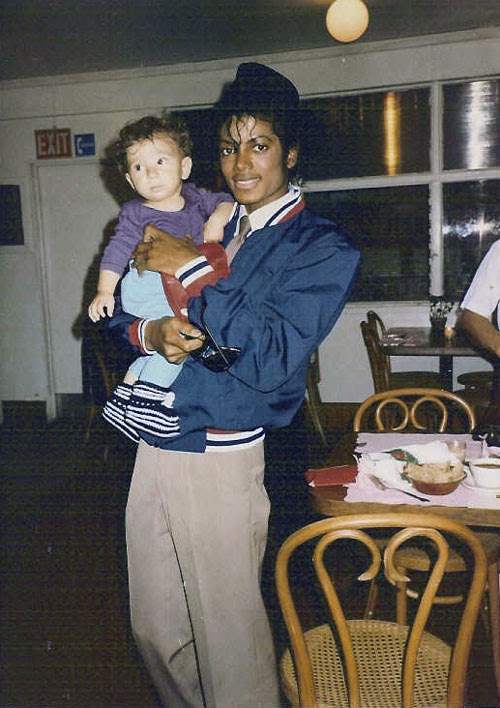
It was just by coincidence that I became acquainted with Michael Jackson. It was 1983 and my wife, Flora, was pregnant with our first child. Frequently, we ate at a vegetarian restaurant called The Golden Temple. Generally we went during the hours between lunch and dinner. There were few other customers during that time period, but there was one other regular: Michael Jackson. He had recently become a vegetarian, and he was fascinated to follow the progress of a vegetarian pregnancy. When our son, Elijah, was born in June, Michael was excited to see him. Once he asked me what it was like to be a father, and he told me that that was what he wanted most of all in life: to have a child of his own to take care of. Even then, there was something poignant about this man who had not been allowed to be a normal child himself wanting to be a father.
On February 18, 1984, when Elijah was eight months old, we took him to The Golden Temple. There were no others customers except Michael and his 13-year-old friend, Emmanuel Lewis, who was known to the world as "Webster." Michael said that he wished he had a camera because he wanted his picture taken with Elijah. My wife had a camera in her bag, but no film. Michael suggested that she could get some film at a nearby drugstore and asked if he and Emmanuel could take care of Elijah while we waited. When Flora returned, Michael suggested various poses and she snapped a number of photos of Elijah with Michael and Emmanuel. Michael asked for copies of the prints when they were developed.
Each of the photos turned out to be of interest, but there was one, of Michael holding Elijah in his arms, that stood out. Looking at it today, 25 years later, and seeing Michael's bright look and clear smile, I can't help but feel sad. He looked healthy, happy and untroubled. His album Thriller had caused a sensation. "Beat It" had been released only four days earlier. And ten days after that afternoon at The Golden Temple, he won eight Grammy Awards. When we next saw him at the restaurant just after his night of triumph, he was beaming, but he also seemed a bit embarrassed by his success.
I got a lot of mileage out of that photo of Michael Jackson and Elijah. Whenever I traveled, I brought with a packet of family photos. The Michael and Elijah photo was the last in the set, and when people got to it, they were usually stunned. Wherever I went, China, Russia, Burma, Tahiti, everyone recognized Michael Jackson. I have to admit that, as a journalist, I used it to put people at ease when I wanted to interview them.
As the years passed, Michael Jackson looked less and less like the Michael in the photo. His skin color changed; the shape of his nose and face changed; and that look of happiness and contentment disappeared.
Now that he is gone, I want to share that photo of Michael Jackson, from a time when he appeared to be at peace with himself and with the world. This is the way I want to remember him.
Source: Huffington Post
sweet, insightful and wonderfully naive interview (1982)
—
6:56:00 am
/
Posted by
badtourgirl
Friday, August 20th 1982, 3:30 P.M. Somewhere in San Fernando Valley. Bob Colacello arrives at the condominium that Michael Jackson and his family are temporarily renting while their house nearby is being redecorated. Michael, who everyone remembers as the boy lead singer of the Jackson Five, has built a solid solo career for himself—his last album, Off the Wall, has sold over 5 million copies in the U.S. alone. Though he also still records with his brothers, now known as The Jacksons, Michael has branched out to work with such superstars as Paul McCartney, Quincy Jones, Diana Ross and Steven Spielberg, all of whom are close friends. While waiting for a phone call from Andy Warhol in New York, BC and MJ began chatting about another close friend, Jane Fonda.
MICHAEL JACKSON: The night that Henry Fonda died, I went over there and I was with the family. They were talking and watching all the different news pieces. Although her father died, Jane was still able to show an interest in my career, asking me have I gotten the film yet, and I thought that was very sweet. I think that they had been expecting him to die for so long. Months and months and months ago she was talking as though it was going to be any day. It happened and there were tears sometimes and laughter sometimes and they ate a little.
BOB COLACELLO: So what are you doing? Have you gotten a movie to do?
JACKSON: Well, right now I'm just finishing up the album [Thriller —Ed.] and concentrating on that. I'm doing the other album as well, the E.T. album, at the same time. That album is a little new for me because I've never narrated a story.
COLACELLO: What is the E.T. album?
JACKSON: It's a storybook album, a double album and I'm narrating the whole story and singing the song which we have to come up with and write. We've been just meeting and talking about it with Steven [Spielberg] for I don't know how long—getting together and talking about making it the all-time storybook album.
COLACELLO: The album you're doing, you've written everything on it?
JACKSON: I've written four or five songs.
COLACELLO: Steve [Rubell] told me you're doing something with Paul McCartney?
JACKSON: Yes. Paul was just here and a song I wrote called "The Girl Is Mine," we sing together on my album. We're fighting over this girl in the song and it came out beautifully. For his album, we wrote and sang two songs together, his Tug ‘O War Part II. But for mine it's the song that I wrote. There's a rap at the end where we're fighting over her. It's funny.
COLACELLO: You're very open to working with other stars. Very often people aren't.
JACKSON: I'm not actually. Not at all.
COLACELLO: You worked with Diana Ross...
JACKSON: Only very special people. I mean, Diana's like a mother-lover-friend to me. She's wonderful. I just wrote, produced, and edited her next single, "Muscles."
COLACELLO: Did you write the lyrics, too?
JACKSON: Lyrics, music—I just finished that and it should be coming out at the end of the month.
COLACELLO: Where do you find the time to do all this writing?
JACKSON: On airplanes. I was coming back from England working on Paul McCartney's album, zooming along on the Concorde, and this song popped into my head. I said, "Hey, that's perfect for Diana!" I didn't have a tape recorder or anything so I had to suffer for like three hours. Soon as I got home I whipped that baby on tape.
COLACELLO: Do you care about politics at all?
JACKSON: I don't like talking about it.
COLACELLO: You don't get into that at all with Jane [Fonda]?
JACKSON: No, we do. She's wonderful. She teaches me all kinds of stuff. When I was on the Golden Pond set I stayed with Jane in the cabin and we were all alone on the water and we'd just talk, talk, talk about everything. It was the greatest education for me—she'd learn and I'd learn and we'd just play off of each other. We talked about all kinds of things, you name it: politics, philosophers, racism, Vietnam, acting, all kinds of things. It was magic.
COLACELLO: Where were you educated, because you were always on the road?
JACKSON: Private schools or tutors.
COLACELLO: You come from Gary, Indiana? What was it like growing up there?
JACKSON: Actually, I was so small I don't remember. When I was five I was touring, singing and dancing. Always gone, always out of school. I just remember little things like the corner store or certain people in the neighborhood. The high school behind us always had a big band with trumpets and trombones and drums coming down the street—I used to love that—like a parade. That's all I remember.
COLACELLO: Did you like performing as a child? Did you always love it?
JACKSON: Always did. I always enjoyed the feeling of being on stage—the magic that comes. When I hit the stage it's like all of a sudden a magic from somewhere just comes and the spirit just hits you and you just lose control of yourself. I came on stage at Quincy's [Jones] concert at the Rose Bowl and I did not want to go on stage. I was ducking and hiding and hoping he wouldn't see me hiding behind people when he called me on. Then I went up there and I just went crazy. I started climbing up the scaffold, the speakers, the light gear. The audience started getting into it and I started dancing and singing and that's what happens.
COLACELLO: How do you compare acting to performing on the stage?
JACKSON: I love both. Acting is the cream of the crop. I love performing. It's a phenomenal getaway. It you want to really let our everything you feel, that's the time to do it. With acting, it's like becoming another person. I think that's neat, especially when you totally forget. If you totally forget, which I love to do, that's when it's magic. I love to create magic—to put something together that's so unusual, so unexpected that it blows people's heads off. Something ahead of the times. Five steps ahead of what people are thinking. So people see it and say, "Whoa. I wasn't expecting that." I love surprising people with a present of a gift or a stage performance or anything. I love John Travolta, who came off that Kotter show. Nobody knew he could dance or do all of those things. He is like—boom. Before he knew it, he was the next big Brando or something.
COLACELLO: He hasn't done much lately.
JACKSON: I know. I think he's choosing scripts and stuff. It's always difficult for anyone trying to compete against their past achievements.
COLACELLO: Tell me, who do you think has made breakthrough in their work in any field?
JACKSON: I love Steven Spielberg so much. I just love James Brown. He's phenomenal. I've never seen a performer create electricity with an audience like James Brown. He's got everybody in his hands and whatever he wants to do with them, he does it. It's amazing. I've always thought he was underrated. I love Sammy Davis Jr., I love Fred Astaire. I love George Lucas. I'm crazy about Jane Fonda and Katharine Hepburn.
COLACELLO: I saw a picture of you with Katharine Hepburn on the set of On Golden Pond.
JACKSON: I feel honored to know her because there are a lot of people she doesn't like—she'll tell you right away if she doesn't like you. When I first met her, I was a little shaky because you hear things about her—Jane filled me in. I was kind of scared. But right away she invited me to dinner that day. Ever since then we've been best friends. She came to our concert—the first concert she's ever been to—at the [Madison Square] Garden, and she just enjoyed herself. We call each other on the phone and she sends me letters. She's just wonderful. I went to her house in New York and se showed me her Spencer Tracy's favorite chair and his private things in his closet, his little knick-knacks. I think he's just magic.
COLACELLO: Are you a fan of old movies?
JACKSON: Oh, yes. There was a lot of great art, great acting, great directing, great stories. When it comes to stuff like Captains Courageous or Boys' Town, Father Flanagan, Woman of the Year—that stuff is unreal.
COLACELLO: Why don't you write a story of your own?
JACKSON: That's what we're working on right now. We're kind of fooling with it, Quincy and Steven and I—hopefully we'll be able to do something with it. Steven wants to do a musical.
COLACELLO: Would you like to do Broadway?
JACKSON: Not yet. I think it's good for sharpening your skills. It's the best for really reaching the zenith of your talent. You go so far and reach the peak of it and you say, "Maybe this is the best performance I can do." What's so sad about the whole thing is that you don't capture that moment. Look at how many great actors or entertainers have been lost to the world because they did a performance one night and that was it. With film, you capture that, it's shown all over the world and it's there forever. Spencer Tracy will always be young in Captain Courageous and I can learn and be stimulated by his performance. So much is lost in theater, so much. Or Vvudeville. Do you know what I could have learned by watching all those entertainers? It would be unreal.
COLACELLO: Most plays are videotaped now, but not every night.
JACKSON: That's the thing. The actor's tense, he's being taped and things are not falling naturally. That's what I hate about Boadway. I feel like I'm giving a whole lot for nothing. I like to capture things and hold them there and share them with the whole world.
COLACELLO: It seems that what really motivates you is your desire to entertain people, to please people. What about fame and money? Could you imagine not being famous or does being famous bother you?
JACKSON: It never has bothered me except sometimes when you want peace. Like you go to the theater and you say, "Nobody's bothering me tonight, I'm wearing my hat and glasses and I'm going to enjoy this film and that's all there is to it." You get there and everybody's watching and staring at you and at the climax of the film somebody taps you on the shoulder for an autograph. You just feel like you can't get away.
COLACELLO: Is that why you live out here in the Valley as opposed to Beverly Hills where all the other stars live?
JACKSON: Yes, but it's just as bad. Beverly Hills is worse because they go there looking for them.
COLACELLO: You're very close to your parents. Do they live out here in L.A.?
JACKSON: Yes. My mother's upstairs. My father's at the office.
COLACELLO: What's your typical day like?
JACKSON: Daydreaming most of the day. I get up early and get ready for whatever I've got to do, songwriting or whatever it is. Planning the future and stuff.
COLACELLO: Are you optimistic about the future?
JACKSON: Yes. I always like to plan ahead of time and follow up.
COLACELLO: Liza Minnelli's a friend of yours, isn't she?
JACKSON: How could I forget her? I'm crazy about Liza. Add her to the list of my favorite people. I just love her to death. We get on the phone and we just gossip, gossip, gossip. What I like about Liza is that when we get together it's all show talk. I show her my favorite steps and she shows me hers. She's a show-stopping performer, too. She has real charisma. In the future I'd like to record her. I think a person like her should be heard on the radio and accepted that whole thing. She's magic on stage.
COLACELLO: Do you care about fashion much?
JACKSON: No. I care about what I wear on stage. You know what I love, though? I don't care about everyday clothes. I love putting on an outfit or a costume and just looking at myself in the mirror. Baggy pants or some real funky shoes and a hat and just feeling the character of it. That's fun to me.
COLACELLO: You like to act a lot just in everyday life?
JACKSON: I love it so much. It's escape. It's fun. It's just neat to become another thing, another person. Especially when you really believe it and it's not like you're acting. I always hated the world "acting"—to say, "I'm an actor." It should be more like a believer.
COLACELLO: But isn't that a little frightening when you believe it totally?
JACKSON: No, that's what I love about it. I just like to really forget.
COLACELLO: Why do you want to forget so much? Do you think life is really hard?
JACKSON: No, maybe it's because I just like jumping in other people's lives and exploring. Like Charlie Chaplin. I just love him to death. The little tramp, the whole gear and everything, and his heart—everything he portrayed on the screen was a truism. It was his whole life. He was born in London, and his father died an alcoholic when he was six. His mother was in an insane asylum. He roamed the streets of England, begging, poor, hungry. All this reflects on the screen and that's what I like to do, to bring all of the truths out.
COLACELLO: Do you care about making money?
JACKSON: I care about being paid fairly for what I do. When I approach a project, I put my whole heart and soul into it. Because I really care about it, I put everything I've got into it and I want to be paid. That guy who works should eat. It's that simple.
COLACELLO: You follow your own business very closely then?
JACKSON: Oh, yes.
COLACELLO: How old are you?
JACKSON: Twenty-three.
COLACELLO: Do you sometimes feel as though you missed out on childhood because you've always been performing in the adult world?
JACKSON: Sometimes.
COLACELLO: But you like people older than yourself, experienced people.
JACKSON: I love experienced people. I love people who are phenomenally talented. I love people who've worked so hard and been so courageous and are the leaders in ther fields. For me to meet somebody like that and learn from them and share words with them—to me that's magic. To work together. I'm crazy about Steven Spielberg. Another inspiration for me, and I don't know where it came from, is children. If I'm down, I'll take a book with children's pictures and look at it and it will just lift me up. Being around children is magic.
COLACELLO: There is something positive and encouraging about them. You have a lot of animals, don't you?
JACKSON: I used to. Right now I only have two baby deer, one's a boy and one's a girl. They're so sweet. They're gorgeous.
COLACELLO: I'll never understand how people can shoot deer.
JACKSON: I hate it. I hate taxidermy shops and all that crap. I have a llama. I have a sheep—he looks just like a ram with the horns. Louie is from the circus. He's the llama. The ram is called Mr. Tibbs and the fawns are Prince and Princess.
COLACELLO: What are you going to do with them when they grow?
JACKSON: Let them go in the yard and stuff. We have just about two acres.
COLACELLO: What kind of car do you have?
JACKSON: A Rolls. A black one.
COLACELLO: Do you like driving it?
JACKSON: I never want to drive. My parents forced me to drive. Quincy doesn't drive. A lot of people I know don't drive.
COLACELLO: Andy [Warhol] doesn't drive.
JACKSON: That's smart. But it's good when you want a little independence to get away. But I don't go many places, I don't know many places. I just drive down the street.
COLACELLO: You don't go out much?
JACKSON: Only to go to the Golden Temple, a health food restaurant. I'm a vegetarian. Or I go to the arcade and play the game.
COLACELLO: Are you interested in art?
JACKSON: I love to draw—pencil, ink pen—I love art. When I go on tour and visit museums in Holland, Germany, or England—you know those huge paintings?—I'm just amazed. You don't think a painter could do something like that I can look at a piece of sculpture or a painting and totally lose myself in it. Standing there watching it and becoming part of the scene. It can draw tears, it can touch you so much. See, that's where I think the actor or performer should be—to touch that truth inside of a person. Touch that reality so much that they become a part of what you're going and you can take them anywhere you want to. You're happy, they're happy. Whatever the human emotion, they're right there with you. I love realism. I don't like plastics. Deep down inside we're all the same. We all have the same emotions and that's why a film like E.T. touches everybody. Who doesn't want to fly like Peter Pan? Who doesn't want to fly with some magic creature from outer space and be friends with him? Steven went straight to the heart. He knows—when in doubt, go for the heart.
COLACELLO: You're religious, aren't you?
JACKSON: Yes, I believe in the Bible and I believe in God who's name is Jehovah and that whole thing.
COLACELLO: Someone said that's why you don't shave.
JACKSON: Oh no! I don't grow anything to shave. That's got nothing to do with it.
COLACELLO: So you're just a basic Christian.
JACKSON: I believe in truth.
COLACELLO: Do you read the Bible?
JACKSON: Yes, a lot.
COLACELLO: Do you go to church?
JACKSON: We don't call it church. It's Kingdom Hall. It's Jehovah's Witnesses.
COLACELLO: You mentioned that you are going to see Bette Midler tomorrow? Are you working on something together?
JACKSON: No, I go to this guy names Seth Riggs. When I sing, I like to get my voice all opened up—like a dancer warming up.
COLACELLO: So, it's like breathing classes?
JACKSON: Right. And right after I do mine, in she comes. She's always on time.
[Andy Warhol calls from New York.]
ANDY WARHOL: Hello?
JACKSON: Hi.
WARHOL: Gosh, this is exciting. You know, every time I use your Walkman I play your cassette on it.
JACKSON: Have you seen Liza lately?
WARHOL: Yes, I did. She was in Europe but then I saw her at Halston's fashion show. She changed her hairdo. Her hair looks more like yours now. It's really curly in front and she looks really different and it's really pretty. She has a great new look. She went out to Halston's last weekend and she's in New York right now. How have you been?
JACKSON: I've been in the studio a lot. Writing lyrics and working on songs and stuff.
WARHOL: I might go see an English rock group at the Ritz tonight called Duran Duran. Do you know them?
JACKSON: No.
WARHOL: I went to see Blondie at the Meadowlands last week.
JACKSON: How was Blondie?
WARHOL: She was great. She's so terrific. Do you know her?
JACKSON: No, I never met her.
WARHOL: Well, when you come to New York I'll introduce her. Going on tour is about the hardest thing to do in the world.
JACKSON: Tour is something—the pacing. But being on stage is the most magic thing about it.
WARHOL: I can't wait until you do a really big movie. Have they asked you to do anything?
JACKSON: My room I loaded with scripts and offers. And a lot of them are great ideas. But the kind of person I am is that I have a person in mind that I'd like to work with and I'm trying to make sure I do the right thing. I just don't want to make a mistake.
WARHOL: Just do them all. You can't make a mistake. You're really good. Did you ever think you'd grow up to be a singer?
JACKSON: I don't even remember not singing, so I never dreamed of singing.
WARHOL: Are you still collecting clothes? Do you have a good designer?
JACKSON: Actually, I don't really get into that unless I'm going on stage. The only thing I like collecting is costumes or pirate coats or things like that. But everyday fashion I don't get into.
WARHOL: What do you wear?
JACKSON: Right now I have on corduroy pants with a big hole in the knee and a pink shirt and tie.
WARHOL: Do you go out a lot of stay home?
JACKSON: I stay home.
WARHOL: Why do you stay home? There's so much fun out. When you come to New York we'll take you out.
JACKSON: The only time I want to go out is when I'm in New York.
WARHOL: Do you go to movies?
JACKSON: Oh, yes. We're going to be working on the E.T. album. I had a picture session with E.T. and it was so wonderful... he's hugging me and everything.
WARHOL: I like Tron. It's like playing video games. Have you seen it?
JACKSON: Yes. It didn't move me.
WARHOL: Well, thanks a lot. See you soon.
JACKSON: I hope so. If you see Liza, say hello. Give her a big kiss and hug for me.
[AW signs off]
COLACELLO: Do you like the Rolling Stones? Do you know Mick at all?
JACKSON: I met him in a bathroom. He was in there with Keith—Keith Moon?
COLACELLO: Keith Richards.
JACKSON: Keith Richards. I came in there and said, "Oh, hi," and we just started talking. Then I just went back into my session. I don't really know him that well.
COLACELLO: Do you read a lot?
JACKSON: Yes. I love to read. I like philosophy and short stories. I like to keep up with the latest best-sellers. The Calendar in the Sunday L.A. Times is my favorite paper. It really lets you know what's going on everywhere. I have my favorite authors—it's not like I just read the best-sellers. I like to see what they are doing and keep with what people are interested in. There's a lot of physical stuff now.
COLACELLO: Do you exercise?
JACKSON: Every Sunday I dance for 30 minutes straight without stopping. I love to do that.
COLACELLO: Why Sunday?
JACKSON: That's just the day I pick. Like I fast every Sunday. I don't eat anything. Just juices.
COLACELLO: Why do you do that?
JACKSON: It flushes out the system, cleans out the colon. I think that's great. To really make it work you have to do it properly. That's the sewer valve of the system. You have to keep that clean like you clean the outside of your body. All these impurities come out of your system because you're not clean inside. It comes out in pimples or disease or through big pores. Toxins trying to get out of your system. People should keep themselves clean.
COLACELLO: You don't read page one of the newspaper.
JACKSON: No. I might look at it but I won't read it.
COLACELLO: Too depressing?
JACKSON: Yes. It's always the same old thing. I like to make people happy. That's what's great about show business. It's escapism. You pay your five bucks to get in and sit there and you're in another world. Forget about the problems in the world. It's wonderful. It's entertaining. It's magic.
Source: Interview Magazine
By BOB COLACELLO, ANDY WARHOL
Photography MATTHEW ROLSTON
behind the seams
—
12:07:00 pm
/
Posted by
badtourgirl
DRESSING MICHAEL JACKSON: BEHIND THE SEAMS OF A FASHION ICON is the first art-driven book about the costumes, apparel, shoes and accessories worn by Michael Jackson, including hundreds of lavish photographs and a behind-the-scenes look into the process of collaborating with him on the making of his wardrobe, written by his longtime costume designer Michael Bush. It’s a fascinating look at the intersection of music and fashion, as well as an homage to Michael’s brilliant fusing of costume, personality, and performance to create his iconic image.
For more than 24 years, Michael Bush, together with his partner Dennis Tompkins, worked personally with Michael to create some of the most original and indelible clothing ever worn by a musical performer. Using their professional background in theatrical costume construction and dance, they created thousands of custom artistic pieces that captured the essence of a one-of-a-kind pop star.
DRESSING MICHAEL JACKSON will feature exquisite photographs of the striking fashions worn by Michael at the height of his career, as well as images showing the carefully planned construction of the clothes to incorporate his unique dance moves and the details of the dynamic fabrics, metals and other materials used. Accompanying text will provide insight into the artists’ methodology and fascinating stories from their decades-long relationship. Their stories are funny and touching, and show a human and artistic side of Michael Jackson not seen in the various other books about him on the market.
The book’s range of illustrations and text will be broad, including the international Bad, Dangerous and HIStory tours, the evolution of the iconic "Thriller" jacket over the years, a patented shoe device the author invented with him that allowed him to recreate his captivating anti-gravity "lean" move live onstage, hand-stitching the trademark rhinestone gloves, dressing Michael off the stage, creating items for Neverland, and encounters with Bubbles the Chimp. The author has unparalleled access to photographs and costumes from his own and the estate’s archives, including many rarely seen or previously unpublished images.
DRESSING MICHAEL JACKSON is also an exclusive look at Michael Jackson's love of fashion and impact on popular culture. A modern day P.T. Barnum and a master illusionist, he had a keen awareness of his role as an entertainer, and a highly imaginative, specific vision of the image he wanted to project — from the military silhouettes and regalia to edgier street looks. For his millions of fans around the globe as well as fashion lovers, DRESSING MICHAEL JACKSON will provide a new and different perspective of Michael Jackson’s artistry, and serve as a lavish celebration of his dramatic sense of style.
Celebrities and fashion luminaries have provided endorsements, including Philip Treacy and Celine Dion. The author will donate a percentage of the proceeds received from the sales of the book to MusiCares.
The book is being published by Insight Editions for release on October 16, 2012. It is available for pre-orders in our online store here at dressingmichaeljackson.com and via the major online book retailers.
Dressing Michael Jackson BEHIND THE SEAMS OF A FASHION ICON
by Michael Bush
DRESSING MICHAEL JACKSON will feature exquisite photographs of the striking fashions worn by Michael at the height of his career, as well as images showing the carefully planned construction of the clothes to incorporate his unique dance moves and the details of the dynamic fabrics, metals and other materials used. Accompanying text will provide insight into the artists’ methodology and fascinating stories from their decades-long relationship. Their stories are funny and touching, and show a human and artistic side of Michael Jackson not seen in the various other books about him on the market.
The book’s range of illustrations and text will be broad, including the international Bad, Dangerous and HIStory tours, the evolution of the iconic "Thriller" jacket over the years, a patented shoe device the author invented with him that allowed him to recreate his captivating anti-gravity "lean" move live onstage, hand-stitching the trademark rhinestone gloves, dressing Michael off the stage, creating items for Neverland, and encounters with Bubbles the Chimp. The author has unparalleled access to photographs and costumes from his own and the estate’s archives, including many rarely seen or previously unpublished images.
DRESSING MICHAEL JACKSON is also an exclusive look at Michael Jackson's love of fashion and impact on popular culture. A modern day P.T. Barnum and a master illusionist, he had a keen awareness of his role as an entertainer, and a highly imaginative, specific vision of the image he wanted to project — from the military silhouettes and regalia to edgier street looks. For his millions of fans around the globe as well as fashion lovers, DRESSING MICHAEL JACKSON will provide a new and different perspective of Michael Jackson’s artistry, and serve as a lavish celebration of his dramatic sense of style.
Celebrities and fashion luminaries have provided endorsements, including Philip Treacy and Celine Dion. The author will donate a percentage of the proceeds received from the sales of the book to MusiCares.
The book is being published by Insight Editions for release on October 16, 2012. It is available for pre-orders in our online store here at dressingmichaeljackson.com and via the major online book retailers.
Dressing Michael Jackson BEHIND THE SEAMS OF A FASHION ICON
by Michael Bush
dressing michael jackson
—
5:24:00 pm
/
Posted by
badtourgirl
Dressing Michael Jackson: Behind the Seams of a Fashion Icon is a fascinating look at the intersection of music and fashion, as well as an homage to Michael Jackson’s brilliant fusing of costume, personality, and performance to create his iconic image. This is the first art-driven book about the costumes, apparel, shoes, and accessories worn by Michael Jackson, including hundreds of lavish photographs and a behind-the-scenes look into the process of collaborating with him on the making of his wardrobe, written by his longtime costume designer Michael Bush.
Dressing Michael Jackson will feature exquisite photographs of the striking fashions worn by Michael at the height of his career, as well as images showing the carefully planned construction of the clothes to incorporate his unique dance moves and the details of the dynamic fabrics, metals, and other materials used. Accompanying text will provide insight into the artists’ methodology and captivating stories from the decades-long relationship between Michael Jackson and his fashion designers Michael Bush and Dennis Tompkins. Their stories are funny and touching, and show a personal and artistic side of Michael Jackson never before revealed.
Michael Bush (Author), John Branca (Foreword)
Publication Date: October 16, 2012
Subscribe to:
Posts (Atom)